Author: Jason R. Johnston

  • Behind the Scenes of Ingress

    Behind the Scenes of Ingress

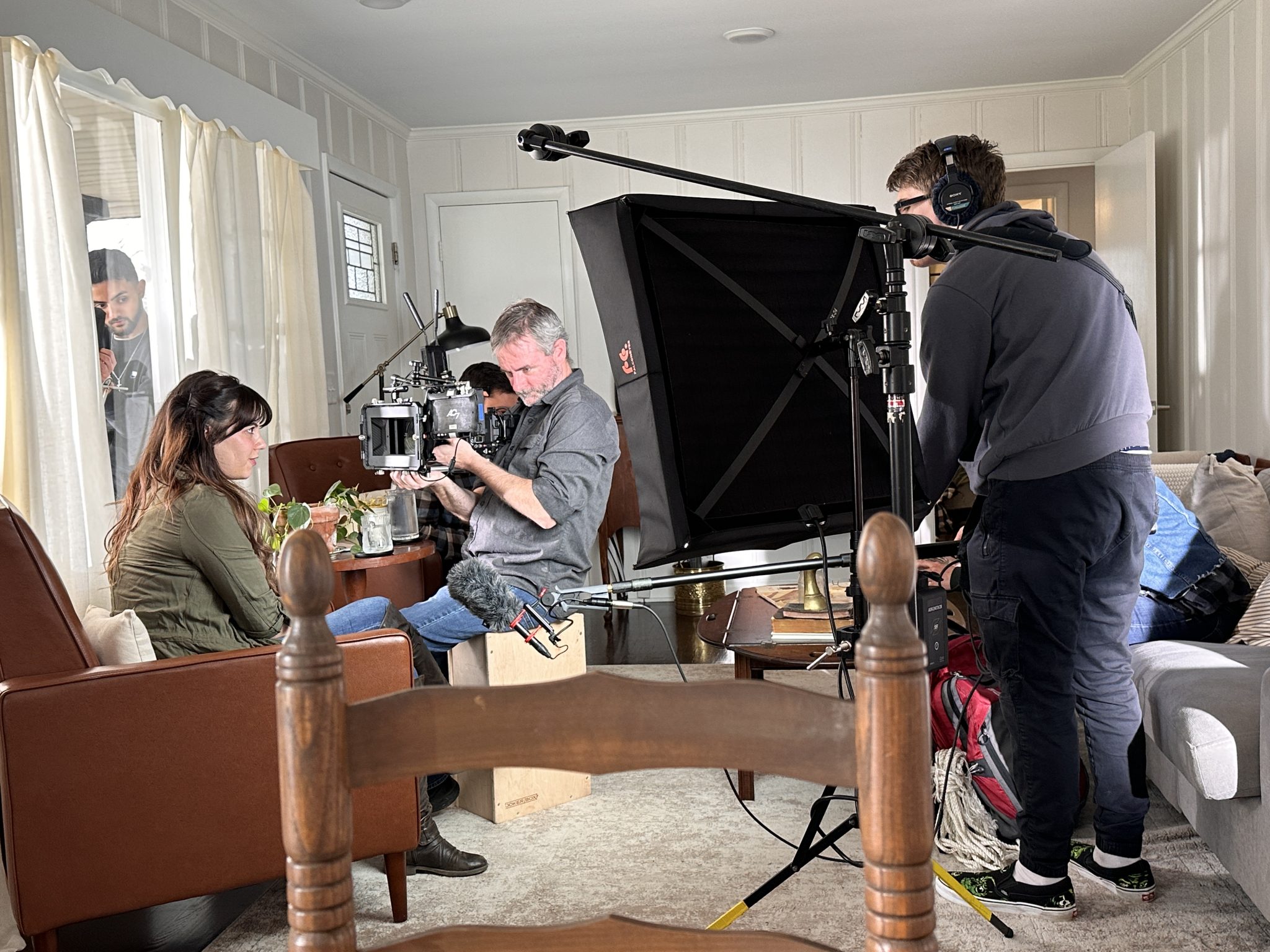
    A little throwback to 2014 when I was the cinematographer on writer and director Christian Blake’s sci-fi thriller feature film Ingress. This behind the scenes video was filmed during principal photography near Anchorage, Alaska, in October 2014.

    Which brings me to that time when a moose visited the set. We had just wrapped at a location and were waiting for the production vehicle to swing by and pick us up when this happened:

    In case you missed it, here is the official trailer of the film:

    I also served as an executive producer on the film.

  • Multi-cam Setup for Commencement Ceremony Livestreams

    Multi-cam Setup for Commencement Ceremony Livestreams

    My secret weapon is the Blackmagic Design Web Presenter with Teranex Mini Smart Panel. The Web Presenter features both SDI (via BNC) and HDMI inputs. The optional Mini Smart Panel gives the Web Presenter the ability to live switch between the two inputs using smooth transitions, as well as monitor the program feed, and access settings more easily using visual menus. This effectively converts the Web Presenter into a two-input live switcher with professionally customizable options.

    My Sony PXW-FS7 Mark 2 would be fitted with a telephoto lens and provide medium podium shots of all the presenters. My Panasonic AG-DVX200, with it’s affixed servo zoom lens at its widest setting, would remain mostly static throughout the events, providing me with something to cut to when the presenters changed. FS7-II and DVX200 would be connected to Web Presenter via SDI and HDMI, respectively.

    The Web Presenter’s outputs are another worthy topic. Yes, the whole point of the Web Presenter is its primary function of converting a high-bandwidth broadcast quality signal and converting it to a 720p H.264 signal that is more easily digested by a computer’s web broadcaster (in this case, my 27″ iMac 5K Retina running OBS to my client’s YouTube Live) via USB. It has SDI and HDMI loop-outs, yes. But, the biggest feature here is Program Out via SDI. This output sits before the conversion happens but after the live switching, meaning the broadcast-quality live switching can be output uncompressed via SDI to a recorder before the coversion to low-quality web deliverable intended for live stream. That means a Full HD copy of the live-switched event can be recorded during the live stream.

    I own an Atomos Ninja Blade Full HD recorder which would be perfect for this job. However, it is HDMI only so I needed a way to convert the SDI Program Out coming from the Web Presenter. Another requirement was the house video switcher needed to be fed an SDI or HDMI signal from my nest so whatever I was livestreaming was also playing live on video projectors in the house. The Blackmagic Micro Converter SDI to HDMI, with SDI Loop-out, was my solution.

    From Web Presenter’s Program Out via SDI to Micro Converter SDI to HDMI’s SDI-In, I then fed the house switcher with SDI Loop-out, and my Ninja Blade with HDMI-out. The Ninja Blade could then be monitored on my SmallHD 7″ AC7-SDI via HDMI. I used two Atomos Micro to Full HDMI coiled cables for this.

    During one of the ceremonies, the client requested a special video be played on the same projection screens as the livestream. To do this, the house video switcher was used to switch between my livestream feed and a Macbook containing the special video. The Macbook used a Thunderbolt (actually, Mini Display Port) to HDMI adapter to feed the switcher the video, plus a 1/8″ TRS to XLR adapter to feed the house audio patch.

  • Sharyland Water Supply

    Sharyland Water Supply

    Day 1

    I was hired by Damaso Creative to DP testimonials and B-roll footage for their upcoming corporate film for Sharyland Water Supply this past week. Shot with their FS100 onto Atomos Ninja Flame in and around Alton, Texas. Lenses were a combination of Rokinon cine primes and Sony E-mount zooms. Key grip was Juan Torres with his grip truck. Grip/PA: Cyndi Rios (also associate producer and talent wrangler) and Janie Martinez. Thanks to producer/director/editor Mario DeLeon for inviting me onto his project.

    Day 2

    Damaso’s in-house DP Manny Botello was back onboard yesterday as we travelled across the Texas towns of McAllen, Mission, Alton, and Sharyland, shooting narrator vignettes with talent Ivette Vargas. I was hired as gaffer this time. Juan was back as key grip with grip Carlos, and Cyndi returned as associate producer/PA. Mario was back again in the driver seat.

    Crew call time was 8 AM at Damaso Creative in McAllen. Because I live in Harlingen I had an hour commute so needed to be up by 6-6:30 AM. Traffic conditions en route become unpalatable by the time you reach the HWY 83/281 interchange in Pharr. The cars are just stopped.

    Our first location was a lovely historic mission situated a few hundred feet from the Rio Grande River separating Texas from Mexico.

    We were visited intermittently by the US Border Patrol and their very loud helicopter which kept interrupting audio takes. It also flew lower and slower over our heads each time! We think they were busy looking for someone.

    Second location was the original water plant in Sharyland. Because it was a wide shot, we had to wait for cloudcover before rolling.

    Our third location was the gorgeous Mansion on Shary whose owners allowed us to film against the backdrop of their home and private pond.

    Lunch time! I ate tacos. Then, I ate tacos the others were too full to eat. Chased by Mexican Coke in a glass damn bottle.

    Fourth location was the Sharyland Water Supply main office where Ivette recorded her outtro (and had slight difficulty saying “rural”.

    After Ivette wrapped, the rest of us headed back to Plant 3 where we captured a few shots of technicians in one of their labs.

    Besides the ~10 MPH wind and the clouds which kept playing peek-a-boo with the sun, nature was kind to us. At 8 AM crew call in McAllen temperatures started at 71°F and did not reach the nineties until we wrapped at 4:30 PM in Alton. Occasionaly passing cars would rudely honk at us throughout the day. Sometimes a plane would fly overhead on its way to McAllen-Miller International Airport, ruining takes. Otherwise, it was a pleasant and productive day.

    Here is the final video as provided by director Mario Deleon at Damaso Creative. I shot the interviews of Sherilyn Dahlberg, Lisa Helle, Roel Treviño, and Joe Guzman, plus some of the b-roll of the hard hat-wearing workers at the construction site and water plant.

  • Blackmagic Pocket Cinema Camera 4K Announced

    Blackmagic Pocket Cinema Camera 4K Announced

    Blackmagic Design unveiled the update to their popular Pocket Cinema Camera at NAB Show 2018 this week, and the little camera looks like a winner.

    The spec on the Blackmagic Pocket Cinema Camera 4K looks fantastic on paper! 13 stops visual dynamic range, dual native ISO (400/3200), sensitivity up to ISO 25600, 5″ touchscreen (featuring the lovely user interface introduced with the Camera 4.0 OS update in October 2016), DCI 4K and UHD up to 60fps, windowed FHD up to 120fps, HDMI-A, USB-C, and 3D LUT support. It also supports ProRes from 422 HQ to 422 Proxy, as well as Cinema DNG and 3:1 and 4:1 lossless raw compression ratios.

    And it’s pretty.

    Powered by standard Canon LP-E6N batteries, Pocket 4K will accept SD/UHX II cards (which, I’m assuming, includes version 5 SDXC media with the new Video Speed Class), but you will need CFast 2.0 cards to enable all the camera’s frame rate and codec options. Also, it will ship with a full license for Davinci Resolve Studio which was recently updated to Version 15.

    The only thing I’m not completely in love with is the sensor not being Super 35 (it’s Four Thirds with an active Micro Four Thirds lens mount), but that’s such a tiny quibble. Everything else is superb, especially if looking at it from the perspective of an independent freelance video producer wanting to graduate from their digital single lens reflex (DSLR) camera, or mirrorless interchangeable lens camera (MILC) to a device that has a familiar form but has all the gooey insides of a proper digital film (read: video) camera.

    Speaking of which the Pocket 4K will also capture stills like a traditional DSLR. This is a cute reverse of the stills camera that also shoots video being that the Pocket 4K closely resembles the form factor of a DSLR or ML body. At this point I can only imagine stills would be captured as Cinema DNG raw up to DCI 4K (4096 x 2160) at either 12 or 14 bits with hopefully a DPI of something better than 200.

    It could be argued the Pocket 4K is the camera the original Blackmagic Cinema Camera 2.5K EF should have been (except that camera probably would have also been 2.5K in 2013). It’s definitely the camera I wish I’d bought from Blackmagic that year! I’m sure the image quality of Pocket 4K will be sublime; at least on par with the Blackmagic Cinema Camera or the original Pocket Cinema Camera. If it’s more like Ursa Mini Pro, that’d be terrific, too. Blackmagic Design says the camera will be embedded with all their color science.

    I can see Pocket 4K being used for quite a lot of projects including stills, especially if it plays well with Canon L glass. I might just have to buy one of these for myself come end of the year! The Blackmagic Pocket Cinema Camera 4K is expected to be released in September 2018.

  • My Cameras: A History

    My Cameras: A History

    Since watching Star Wars (possibly The Empire Strikes Back) as a wee little baby I had always been interested in photography, cinematography, and the moving image. Cameras, therefore, have been a large part of my life since the very beginning. Following is a history of my cameras (and me) throughout the years.

    In my youth (pre-high school) I had used the Kodak 104 Instamatic, a little plastic point and shoot 110 film camera. It changed my life, and I would not use an SLR camera until high school. In 1994 I was introduced to 35mm single lens reflex cameras with the Pentax K-1000, an inexpensive amateur device that required no batteries unless you wanted to take advantage of the exposure meter in the viewfinder. The K-1000 was assigned to me in journalism class during my sophomore year in high school.

    The next year, I was asked to take over the photography department while the journalism supervisor dealt with the reporters. I was then responsible for teaching use of the cameras, dark room technique and basic photography etiquette to my peers and upperclassmen students alike. And I was good at it. The kids learned a lot and their photographs got better as the semester trolled along.

    My senior year, the school upgraded to the Canon EOS Rebel. Gone were the days of K-mount fully manual, heavy metal cameras. Now, you could have a fully automatic experience with little photographic insight in a plastic, lightweight camera with an on board flash. These new auto focus cameras needed batteries and the consumer-class zoom kit lenses weren’t as sharp, fast or precise as the Pentax’s 50mm primes, but the Rebel did auto forward the film.

    After graduation, I signed up for a Discover Card on my way out of an English class my first semester of college. One of the first things I ever purchased on a credit card was a Canon Rebel XS-II kit along with a Canon case from Best Buy. The setup worked fine for several years until one day the curtain stopped working. I never sent it in for repair and because of my hectic work schedule, I silently walked away from photography.

    In 2002, after shooting some short films and getting my schedule in order, I decided to pick up a Canon PowerShot G3. I figured digital was the way to go for an uninterested consumer like myself and that’s because years ago I swore that I’d never go digital anyway. But that was also when I swore I’d never leave photography.

    The G3 worked great as I started to feel the pull back to photography. In 2003, I figured I would stay digital and move up toward the SLRs again: this time I got the Canon 300D Digital Rebel. The Rebel worked great until I dropped it after one of my first model shoots (in fact, I think it was my second model shoot ever) in 2004. The damage to my Rebel was an excuse to upgrade to the Canon EOS 20D.

    Four years later, the 20D has been so good to me, I hadn’t been concerned with upgrading camera bodies at all. Focusing instead on purchasing lenses such as the Canon EF 50mm f/1.8-II normal prime lens, as well as investing in a few affordable Canon L-series lenses. Because a camera body is just a light-tight box with a hole in it. Image quality and control is all about the glass in front of the body. I purchased a Canon EF 17-40mm f/4L USM normal/wide zoom lens, and a Canon EF 70-200mm f/2.8L USM telephoto zoom lens.

    In 2008 I decided to apply what I had learned about photography up to that point back into 35mm film. One of those “if only I knew then what I know now” things. I went old school and won at eBay auction the Canon FD-mount Canon AT-1 and a fast Canon FD-mount prime lenses. I also purchased a Canon PowerShot SD1100 IS as I began to value smaller cameras that could fit in my pocket and take anywhere. This was also the year I purchased a Sekonic light meter and began to properly expose myself to, well, proper exposure. The AT-1 is sitting on a shelf, while the SD1100 eventually was submerged in water and never recovered. 2008 is also the year I began to try my luck at videography and cinematography.

    After working on a few short films in 2008 and 2009 I realized that cinematography made me very happy. So, in March 2010 I purchased a Canon EOS Rebel T2i for the purpose of honing my video and cinema skills, as well as to supplement my indefatigable 20D. The 20D eventually began to eat my CF cards and died in the middle of a commercial jewelry photo shoot. Luckily, I had the T2i as a backup and so decided it was time to retire the 20D after six years of professional use. I wound up shooting quite a lot of short films, music videos, and television commercials, with my faithful T2i over the years, even as the rubber bits began to peel off due to the heat, salt water, and sand, and other rough elements I constantly exposed it to. April 2016 my little T2i died on a dry rental. I still haven’t gotten it back from whomever still has it.

    June 2013 I was finally able to purchase the Blackmagic Cinema Camera 2.5K EF (BMCC), paid in full by a commercial job for a furniture store client. The camera worked flawlessly on its trial run, however the hard drive I saved the footage to did not. I lost most of the footage, pissed off the client, experienced the positive side of having a paper trail (contracts, release forms, etc), and learned a valuable lesson in backup redundancy.

    January 2016 I was able to purchase my first 135-format digital camera, the Canon EOS 6D. An upgrade from the soon-to-be-DOA T2i, the 6D became my primary photography camera until I decided to use it to also replace the BMCC to shoot documentaries and other video work I really needed a proper video camera for as the BMCC was too damn clumsy to work with.

    I finally got that proper video camera in May 2016 when I purchased the Panasonic AG-DVX200 from a vendor in Dallas, TX. The DVX200 has served the 90% of my client work: videography. Because DVX200 also sported a logarithmic profile, I decided to also use the camera on jobs where I might normally have preferred the BMCC and its superior ProRes codecs or CinemaDNG raw, such as television commercials and short films. But, the DVX200 was much simpler to work with, despite its limited 8-bit 4:2:0 codec that was only about as good as the T2i ever was. DVX200 continues to serve me for video work, but I knew I would need a special camera for that other 10% of my work: cinema.

    July 2017 I took to the skies with the DJI Mavic Pro and began to pursue legitimacy as a commercial UAS remote pilot.

    Taking on a job as a state college marketing department’s photographer (read: button smasher), I began to lose my love for the art. I decided I needed a focused, deceptively simple, but most of all fun, camera only to be used for stills in an effort to rekindle the passion. That camera, to me, was somewhere in Fuji’s X100-series. Over the years I had been thinking about the X100 cameras, and as I began to grow tired of what used to be my biggest passion in life, I decided to take the plunge on the most up-to-date, most mature, and most fully realized version of the series. So, in August 2017, I purchased my Fujifilm X100F. It’s the kind of camera I can take with me anywhere, it communicates with my iPhone and I can make pretty photos with it in just about any situation. The film simulations are adorable. It’s fast, nimble, and challenges me to be a better photographer and artist in every respect. I adore my X100F.

    February 2018 was finally the time to get that special cinema camera. After years of careful consideration, I decided to purchase the Sony PXW-FS7M2 from a vendor in Austin, TX. A mature, improved FS7, the Mark 2 is pretty much everything I ever wanted in a specialized cinema camera, as well as in a general purpose video camera. The locking lever E-mount and electronic variable ND filtration were the paramount reasons for considering the FS7M2 over the original – and slightly less expensive – FS7. Combined with a lovely CineEI mode and a certain set of LUTs, I am convinced I own now a miniature Arri Amira. So far I have only used it a little bit (just bought it a few weeks ago) but it is proving to be my most favorite camera I’ve ever owned. I can’t wait to see what the future has in store.

    June 16, 2019 – Purchased a GoPro Fusion 360 at Best Buy in Brownsville, Texas.

    December 7, 2019 – Purchased a Canon EOS 6D Mark II at Best Buy in Brownsville, Texas, along with a Canon EF 50mm f/1.4 USM, Canon EF 85mm f/1.8 USM, and Canon Speedlite 430EX III-RT external flash.

    April 10, 2021 – Purchased a Sony a6400 at Precision Camera in Austin, Texas, after a Mother’s Day photo session.

    October 7, 2022 – Purchased a RED Komodo through B&H Photo’s website. I was able to pull the trigger on this after careful consideration since the camera’s announcement, and upon being paid for working on the feature film M30 Oxy as DP. As of November 21 I have filmed pickups for Big Trip’s Phoenix, shot a commercial for Intrigue Boutique, and the music video for Ainsley Costello’s Cherry On Top. Because of it’s size, ease of use and customization, and easy ProRes workflow with Final Cut Pro, the Komodo has quickly become my most favorite camera I’ve ever owned.

    This article was originally titled “My Photo Cameras: A History” and written July 5, 2008, before I became a cinematographer.

  • Rio Vista Dentistry Branding Film

    Rio Vista Dentistry Branding Film

    Day 1

    December 8, 2017 – Snow day! Somehow the weather worked out perfectly for snow in subtropical south Texas. Perfect for anyone who has yearned to build a snowman on the beach, but not perfect when I am supposed to be shooting evergreen exterior footage of the Allure Dental office in Harlingen, Texas.

    Today I photographed stills images of the doctors and staff at Rio Vista Dentistry to populate their upcoming newly designed website. Portraits were shot of all key staff members, as well as a few groups for Christmas cards.

    I then began video recording of b-roll footage of the doctors and staff at work for a branding film I will produce to coincide with their new website. As I shot 4K video footage with my DVX200, I would then simply stop the action and capture stills photos with my 6D. This way both the photos and the videos would have a similar look: same lighting, same angles, same fields of view.

    Once I wrapped the staff, I walked the office with Mavic Pro (which I intended to record jib-like exterior shots but was outgunned by Nature) and recorded Steadicam-like flying shots of the office interiors using Mavic’s gimbaled 4K camera.

    After breaking for lunch, we returned to the office to capture patient testimonials. It’s difficult as a solo shooter without assistance running an interview whilst also being aware of the camera, sound, and lights. But, I managed to get it all done on time and on budget. Everything went smoothly, the doctors were impressed and I was gifted a bottle of red wine. The doctors interviews and exteriors will need to wait for another day.

    Day 2

    January 19, 2018 – Early this morning we continued production of the branding film as I was scheduled to interview doctors Bonnie and James. As always I generally prefer to travel light when in one-man-production mode. I trollied my DVX200, three Dracast 1×1 LED light kits, audio gear, tripod systems, and light stands, in just a few bags. Each interview lasted about 45 minutes. I still need to grab exterior shots and a few shots of the lobbies and other area of the office with exterior views, weather permitting.

    Day 3

    February 6 – Today the weather finally cooperated and we were able to continue production of the branding film. This is the first project I was able to use my new Sony PXW-FS7 Mark II on as I just purchased it in Austin three days before. I was finally able to fly my Mavic Pro before the office opened after lunch to grab some lovely jib-like exterior shots. Also, I shot redux portraits of doctor Bonnie.

    Once the film is completed it will become available to the web developers who will place it on the new website for its launch.

    Delivery

    February 20 – Finally delivered! Assembled and finished in Final Cut Pro X, the film is a brief tour of the office and overview of their services, peppered with patient testimonials, as well as informative monologues by the doctors, all tied together with succinct narration. Told with minimal effects or graphic embellishments, and some lovely dramatized footage of the staff in action, the delivered branding film for Rio Vista Dentistry is just shy of five minutes in total duration.

    Rio Vista Dentistry loved the final film and approved it with zero feedback or revisions.

  • My Next Camera Revealed

    My Next Camera Revealed

    After months of deliberation (and a bit of saving up), I finally decided on my next cinema camera. Upgrading from my old Blackmagic Cinema Camera 2.5K EF I purchased in 2013, plus some heavy lifting by the DVX200 and 6D, I felt it was time for a change.

    Considering all the types of digital video work I do, I am in need of a Swiss Army knife: a camera that can be used both for ENG and film-style work. A camera that feels just at home with a servo-zoom broadcast lens or a fast cine prime. A camera that can give me UHD at 4:2:2 10-bit with an Intra-frame codec at reasonable Mbps rates, but also give me an option for DCI 4K raw if I need it at a later time. A camera that works right out of the box without a lot of rigging. Plus, I do not want to be handicapped by a miniscule option of lens mounts.

    I decided on the Sony PXW-FS7M2.

    Here’s why.

    The main reason is the Lever Locking E-mount. That versatile mount sits in front of the same Super 35 sensor used in the F5 CineAlta, but in the more compact body of an enhanced FS7.

    Second reason is the incredible electronic ND with stepless intensity from two to seven stops of light reduction without perceptable color shifts or other degradation.

    Third reason is as much as I’d enjoy an EVA1, by the time I’ve purchased other bits to rig it up to the out-of-the-box level of an FS7, I might as well have purchased an FS7. Also, I feel the price difference between the FS7 and FS7M2, given that both items from the first two reasons above are both exclusively for the FS7M2, is a justifiable price for a worthwhile upgrade.

    Also, I believe the FS7M2 will provide a suitable platform for ‘future-proofing,’ including further customization and expansion such as cinema rigging, various lens mount adapters, monitoring, brick battery system integration, power and signal distribution systems, wireless video taps, and other modifications, all of which may be securely bolted into the system so it behaves as an integrated unit rather than a DIY ‘frankenrig’.

    Though I have long been vocal of my dislike for “Sony colors”, the FS7-series’ CineEI mode and the ability to view or bake in LUTs, has changed my mind. Even the classic Custom mode with it’s SLOG options and matrix flexibility have won me over in recent tests with the fully upgraded mark one FS7, particularly tweaks to match color between FS7 and Arri Amira. I believe FS7M2 is clearly a tool that is only as good as the human using it. I always look forward to using a tool that works just as hard as I do.

    I intend to purchase my Sony PXW-FS7M2 next week in Austin. Did someone say ‘roadtrip?’

  • What’s Inside the South Texas ISD TV Spots

    What’s Inside the South Texas ISD TV Spots

    A total of 28 video advertisements, 14 radio ads, 7 audio interviews, portrait photography, coordination of an entire magnet school district spread across 3 counties along the Rio Grande Valley of south Texas, with English and Spanish deliverables, running on broadcast television, and select Cinemark movie theaters. All tying in to a single website: insideSTISD.com. Another epic project I produced, wrote, and directed in collaboration with South Texas ISD.

  • Fujifilm X100F: Why I Love It

    Fujifilm X100F: Why I Love It

    If you read my blog and visit my website, you know I am a cinematographer and pro photographer. I have lots of cameras; my new X100F is only one of them. Film, digital, video, medium format, 135, APS, 1/6″, 1/3″, 2/3″, 1″, 4/3″, Super 16, DCI 4K, whatever the iPhone 7 Plus sensor is…and those are the ones I own. Lots of lenses and several types of lens mounts: some modern, some antique. I’ve been on shows where we rented Red Epic, Sony CineAlta, Panasonic Varicam, and others. Also, I’ve literally been in the business for 20 years. X100F only arrived at my doorstep yesterday, and it’s already become my favorite “every day” camera. I’ve never known a camera this small which packed this big a punch. I have never had a leaf shutter in a compact digital camera at this price. It is unreal.

    If you are merely an enthusiast and want to leave the world of heavy SLR cameras and interchangeable lens systems, then sell it all, buy a silver X100F, fancy brown leather case, a red soft shutter release button, a couple spare batteries, maybe the generation II wide and tele-converters, a fast 64GB SanDisk Extreme Pro card, and a nice vacation for you and the wife. Then take tons of lovely film-emulated photos of said vacation. You’ll be happy as a clam.

    If you’re a pro photog and need the interchangeable lens system and like the 135 format, then still get a X100F and build up to all the accessories.

    If you’re a pro and want interchangeable lenses but aren’t married to what plebians call “full frame”, then seriously consider selling your gear and investing into the current generation of Fujifilm cameras. The APS format is no slouch.

    My first X100F panorama, processed with VSCO’s C9 preset on my iPhone 7 Plus.

    It doesn’t matter if your primary format is medium or large, or if you’re a n00b who doesn’t know what the exposure triangle is or the difference between parfocal and varifocal, X100F is an amazing little camera. It is helping rekindle my burnt-out love for photography.

    6D, VSCO, C9

    I got my X100F yesterday. I’ve been a photographer for over half my life, but I had never really fallen in love with a camera system as I have with the X100 series. X100F was finally the one I decided was amazing enough to buy (the ISO dial, right-hand placement of buttons, and Acros film emulation clinched it for me) and I don’t regret a thing. For the first time in years, yesterday, as I was shooting my first tests, I found myself having fun. X100F is great.

    A quick selfie through the doorway. Processed with VSCO with c9 preset

    Get X100F if you want stellar image quality in a small camera body with precise tactile controls, regardless of what camera system you’re used to currently.

    I have zero qualms calling myself a pro with just X100F hanging around my neck.

  • I Will Now Fly A Drone For Work

    I Will Now Fly A Drone For Work

    It’s true. Now that the dust is beginning to settle on the “drone” legality craziness, and the FAA is getting a handle on how to proceed, in response to my previous opinion on this subject, I am now comfortable with owning and operating an Unmanned Aerial System (UAS) for work and play.

    As I prepare for obtaining an airman certificate and commercial UAS pilot’s license, I have already purchased, registered, and flown, my new DJI Mavic Pro. I received it on Friday, got the batteries charged and had it in the air without fuss before the sun went down. Later Saturday I got the camera settings where I wanted them.

    On Sunday I played with the Mavic Pro around my favorite Baptist camp, Cone Oasis, which was unnoccupied by clients at the time. I had the following test video (which I treated seriously as a short film) finished a few hours later.

    I’m looking forward to offering UAS aerial cinematography and photography services to my clients.

    Also, today is my birthday. What a nice way to celebrate and kick off the new fiscal year.

  • Panasonic AU-EVA1; my next cinema camera?

    Panasonic AU-EVA1; my next cinema camera?

    The big preview of Panasonic’s newest cinema camera, seated comfortably between Varicam LT and GH5, happened at Cine Gear Expo in Los Angeles Friday afternoon. Introducing the Panasonic AU-EVA1. I am astounded at how many of my needs EVA1 checks off my list for a cinema camera upgrade. She also added a few things to the list I couldn’t have imagined I’d be able to personally afford in a new cinema camera. EVA1 winds up being a miniature Varicam LT, without the Varicam badge, price, or weight. The specs previewed so far are jaw-dropping.

    EVA1 will feature Varicam colorimetry, proper V-Log and V-Gamut. It’s DCI 4K will be subsampled from a bran-new 5.7K Super 35 sensor, recording to an internal 10-bit 4:2:2 Intra codec at up to 400Mbps on SDXC cards (I will probably want to invest in the new V-class). It will also, eventually, output 5.7K raw over SDI and/or HDMI. It will work with DVX200 batteries. It will do 4K up to 60fps, as well as 2K up to 240fps. Still being tweaked, EVA1 will have some flavor of dual native ISO, probably close to Varicam LT’s settings of 800 and 5000. It has built-in ND, EIS, and a swing-away IR cut filter. The top handle, LCD, and side grip, are removable and repositionable. It also sports an active EF lens mount that most likely will be able to communicate with most fly-by-wire EF lenses and be able to control them with buttons on the camera body for iris and auto focus, if you’re into that sort of thing. Also, EVA1 is not bad to look at. The button layout is nice and the black-with-red-trim motif is sexy.

    My teeny-tiny complaint is that the EF mount is not a positive-locking one. Would that keep me from favoring EVA1 over, say, Blackmagic’s Ursa Mini Pro? Nope. Not at all. In fact, the only thing BMUMP has going for it now is it’s interchangeable mount system. That’s about it. Every other tick goes in EVA1’s favor. With the EF-mount, I will be able to utilize my set of SLR Magic APO Hyperprime Cine T2.1 25/50/85mm PL-mount lenses as I have a lovely EF-PL adapter that works extremely well. As I am also a stills photographer who uses Canon equipment, EVA1 should work beautifully with my little collection of medium-fast EOS “L” zoom lenses.

    EVA1’s price, which Panasonic says will be ‘under $8,000’, is enticing. Ursa Mini Pro’s price ($5,995), plus Shoulder Mount Kit ($395), 256GB Cfast2 card ($580), V-mount battery plate ($95), and a 14.8V 95Wh battery ($247), comes in at a bit more than $7,311 as a working system. “Under $8,000” could literally mean “$7,999,” but everything in the box is what I’d need. All I have to buy at that point is a few V90 SDXC cards which are far less expensive than Cfast2 cards. The batteries I already use with DVX200 will work for EVA1, as will my custom shoulder mount kit I slapped together with components from SmallRig and Zacuto.

    Speaking of “competition”, Canon recently announced it’s new EOS C200. Basically an 8-bit 4:2:0 35Mbps camcorder that primarily shoots 4K in a compressed version of Canon’s proprietary raw format, utilizing the EOS C700 sensor, at a measly 150Mbps. The lackluster announcement was, for me, a momentary diversion for a product which I don’t find appealing. Later, Sony announced they had a thousand personnel working on a new 135-format (“full frame”) sensor CineAlta that’ll come out at some point in a few years, be really expensive, and will prove to be a PITA to pull focus on.

    No thanks.

    It’s also no small thing that EVA1 is petite: less than 7″ long, and less than 6″ wide and tall. She also weighs less than 3lbs. She’s pretty much perfect for jib and stabilizer work, as well as being outfitted for heavier rig work, but with a total rig weight of “not very much” since EVA1 already is light as a feather. A few extra pounds won’t make a lot of difference, I don’t think. I’m sure she’ll be quite strong as I’ve always been impressed with Panasonic’s build quality. To put it bluntly (and to echo a joke from the movie “Airplane”), I like my cameras the way I like my women: petite, smart, strong, and black…with red trim. Joking aside, I think EVA1 is an absolute winner.

    A few niggles: it’s unclear at this point what the exact dual native ISO specs will be. We also have no idea what the new sensor’s dynamic range will be, or if AU-EVA1’s image quality will be anywhere near par to the AU’s sister Varicam line. We also don’t know what the actual MSRP or street price will be. Some other people are very interested in EVA1’s ability to auto focus with EF lenses, as well as what it’s OIS compatibility will be. I’m not personally interested in either of these functions, so it’s not really a thing, but some people are concerned so, for them, it’s worth mentioning. What is of concern to me is how the internal codecs will all play with each other, as well as what sort of sensor cropping are we looking at depending on codec, recording format, frame rates, etc. But, these are all little things that Panasonic is tweaking and will disclose in full before the camera ships this fall. Again, I’d prefer a locking EF mount, but having a bayonet version is not a deal breaker.

    Is the Panasonic AU-EVA1 my next cinema camera? I believe EVA1 could be a stellar addition to my small family of motion picture cameras, partially retiring my Blackmagic Cinema Camera, and allowing my Panasonic AG-DVX200 to focus on what it does best: reality/ENG work. It would be my intent for EVA1 to handle the TVCs, music videos, shorts, and feature films that come my way. I can’t wait to see what EVA1’s official specs will be when they are announced later this year. Panasonic says EVA1 is on track to be released by the end of 2017. I still need to see footage to be sure, but I’m looking forward to holding her in my hands soon and seeing what she’s made of. That’s when I’ll really know.

    Resources:
    http://business.panasonic.com/AU-EVA1.html
    http://business.panasonic.co.uk/professional-camera/camcorders/AU-EVA1-cinema-compact-camera-for-cinematic-moments
    http://pro-av.panasonic.net/en/eva1/index.html

  • Panasonic’s “Next Camera”

    Panasonic’s “Next Camera”

    There is only speculation at this point. Panasonic has announced a new cinema camera at NAB Show 2017 this week. However, that’s all anyone really knows. There are exactly zero details about the camera released by Panasonic during the tease. Panasonic representatives on the NAB Show floor have offered only scanty hints of what this new camera is all about.

    A mock-up of the new camera rests under veil within a thick glass case at the Panasonic booth at NAB Show between the new GH5 and the current Varicam line-up of LT, 35, and Pure. This suggests a camera that fills that void, offering more capability than the GH5, a stills camera, but not as robust (or expensive) as the Varicam LT. The bullet points above the veiled prop admit the camera is “small and light,” has “cinematic imagery,” will feature “low-cost media, workflow,” and will be “available Fall 2017.” That’s it. When asked what to call this new mystery camera, Mitch Gross, Panasonic North America’s Cinema Product Manager, during an interview stated simply it is Panasonic’s “next camera.”

    How soon until the full reveal? Thankfully, that will come the first week of June at Cine Gear Expo in Los Angeles, only five weeks away.

    Personally, I have been dreaming of a successor to the venerable, yet under-appreciated, AF100 from 2010. Being an owner/operator of DVX200, I am in love with the fixed-lens camcorder for video projects and some cinema-style work such as TV commercials and music videos. However, the DVX200’s biggest advantage is also it’s biggest obstacle: the fixed lens. It’s a great lens, but having a uni-body camcorder means I never will have the option to use something else. I’m stuck with that lens. Don’t get me wrong: it’s actually wonderful to never worry about changing lenses, carrying those lenses with me everywhere, risking dropping them during a change, dirtying up the sensor, and other things; but, man, it sure is nice to change lenses sometimes.

    For the majority of my work over the past few years has been reality in-nature. I’ve shot a lot of corporate videos, event videos, wedding videos, interviews, news segments, et cetera. Before I purchased DVX200, I was using my current cinema camera, the Blackmagic Cinema Camera 2.5K EF which I purchased in 2013. Also, a great camera, but hell to use in a reality situation. The cage and rigging makes it bulky and heavy, the lenses need to be changed. There’s no ND wheel. White balancing is a chore. Audio has to be recorded externally, and there’s a big brick battery lazily affixed to the cage. It’s fine for a controlled set, but daunting when covering an event; something that only happens once.

    With DVX200, since May of last year, I’ve only shot a few projects with the Blackmagic Cinema Camera as the majority of my work has been videography. 2016 was also the year I finally purchased a set of proper cinema lenses: the PL-mount SLR Magic APO Hyperprimes. Now, I need to start looking at upgrading my cinema camera. Lately, I have been eyeing the Blackmagic Ursa Mini Pro. However, I most likely will not be in a position ready-to-buy until end of the year. With Panasonic’s tease of a new cinema camera that just might be a spiritual successor to the AF100, or a straight-up AF200, my interest is piqued.

    Panasonic Pro Europe posted this to their Instagram account.

    I left the following comment:

    So, I’m going to go out on a limb and guess it’s [basically] an AF200: DVX200 body and features, m4/3 lens mount (with Super 35 sensor?), internal 10-bit 4:2:2 ProRes (please!) up to DCI 4K, and that flipping LCD has a snap-on loupe. I imagine it’d actually be the same 4/3″ sensor in the GH5. Not a Varicam, but would play well with V-log L. 13 stops of dynamic range? Probably aiming to compete with FS5 and 7, and C100-300. Might even be a non-raw competitor to Ursa Mini, and if it’s priced lower, all bets are off. Whatever this thing is, I am excited. We’ll know at Cine Gear Expo…

    Looking at the lens in the silhouette image, it is definitely a Sigma 24-35mm F2 DG HSM Art. I’m going to venture that is a fixed EF mount. I would imagine it is a M4/3 sensor, however, Panasonic might be alright with letting us have a Super 35 sensor. It’s not going to be a Varicam. It’s going to be a spiritual successor to the AF100 (or, the AF200). It has the same silhouette as the DVX200, minus the rear EVF and affixed lens. AF100 was basically an HVX200 body. This seems like the logical progression of things. It took forever for a successor to DVX100, and it was announced in 2015. I think this would make sense to announce an AF100 successor (again, either spiritually or a literal AF200), that would share the concept of the DVX200, but with an interchangeable lens and, hopefully, better internal codecs. Has anyone noticed that the LCD swivels horizontally (yaw roll)? That, by itself, is exciting.

    Personally, I’d love an Ursa Mini Pro…unless something better comes along at the same or better price when I’m ready to buy. And, technically, i am doing just fine with my current cameras so I don’t want to upgrade my cinema camera until I can afford to do so, and with a product I know will serve mine and my clients’ needs. But, I have a cinema camera. I needed to upgrade the video camera I bought in 2010, so I bought the DVX200 (again, I would LOVE a cinema camera in a DVX200 body). Then I needed cinema glass, and then a nicer field audio recorder, etc. Late 2017/early 2018, I’m looking to upgrade the cinema camera I bought in 2013. Ursa Mini Pro has been the top contender. Who knows about this new Panasonic? I like Panasonic very, very much. So, even if it doesn’t do internal raw, if everything else is very strong, my choice could definitely go in Panasonic’s direction.

    Meanwhile, user Osslund on DVXuser posted the following rumor yesterday:

    Just got this info about the new camera. It will have a S35 sensor and 14 stops of dynamic range. 4k up to 60fps. 1080p up to 120fps. All the usual stuff like ND, SDI/HDMI out. The body is very light weight at about 1 kg. Media used will be SDXC cards with dual slot capacity.

    The camera pars [sic] can be broken down and the shape of the camera is a mix of C100 and FS5. As is the price in the league of a C100 mkII.

    If even parts of that are actually correct, Panasonic’s “next camera” could very well be an Ursa Mini Pro killer for me. Regardless, the prospect of an “AF200” is super exciting. Too bad I can’t be in Las Vegas this week to try and peak through the cloth.