Tag: Panasonic AU-EVA1

  • Is It Worth Investing In Lenses For Micro 4/3”?

    Is It Worth Investing In Lenses For Micro 4/3”?

    Tyler Kraft posted this question on one of the many filmmaker Facebook groups I’m a member of:

    I recently choose to go with a Panasonic GH4 as my main camera that I plan to use for my upcoming low budget film. What do you all think of the Micro 4/3 sensor size? Is it worth investing in some lenses for it? Any suggestions for (cheap) lenses? (I have the Panasonic 14-140 and a speed booster to use a Nikon nifty fifty and Nikon 35-70mm F3.5 AI)

    Here was my reply:

    Micro 4/3” is similar to Super 16 and lots of modern mainstream movies are shot on S16 film: Fruitvale Station, Black Swan, Hurt Locker, Moonrise Kingdom, Leaving Las Vegas, and Clerks all come to mind. My DVX200 has a 4/3 MOS sensor (and affixed 13x zoom lens) which I shot tons of cinematic work with. I even shot a feature film using the original Blackmagic Cinema Camera (M4/3) and cine lenses intended for Super 35.

    M4/3 is just a format. It provides a look as if you were choosing a film stock. It’s hard to get the background out of focus? So what? What if you want deeper focus? When I shoot 135 (approx Vistavision) I’m always stopping down to achieve deeper focus. It is incredibly hard to pull focus handheld at T2 on a “full frame” sensor LOL. I knew a DP who only liked to go T4.5/6 split in S35, but I was very thankful because I was his 1AC LOL. Anyway, M4/3 (S16) is just a format, like S35 or 135 or S8 or IMAX, etc; you choose the one that’s right for the project and its budget.

    Regarding lenses: do not invest in lenses for a small format. Invest in lenses that cover syltandard formats like S35 or large formats like 135. A few years ago I invested in fast PL mount cine lenses (T2.1) that cover up to 135 format (what YouTubers call “full frame”, whatever that means). With a solid PL mount adapter I can adapt the lenses to almost any camera whose flange is shallow enough, including M4/3, E, RF and EF. The nice thing about M4/3 (and other mirrorless mounts) is the flange is so shallow you can adopt almost any sort of lens you like. So there’s no reason to get a cheap consumer Panasonic lens just because you bought a GH4. Use that speedbooster with that Nikon. Shoot a whole movie with it. Or get another Nikon lens that’s wider if you need it. The lenses usually only provide a little bit of character to your movie’s look. The lenses are not going to be what really affects how the movie looks. The lighting is.

    Lighting and composition are the things that will make or break how your movie looks. The tools used on set only marginally affect the look; what they really do is affect how well you work on set. Good tools are effortless to work with. Crap tools are crap and slow you down and suck. Invest in good tools if you’re really taking this movie thing seriously…

    GH4 is just okay. It’s a horrible filmmaking tool because it’s a stills camera. Stills cameras have to be rigged out a bunch to make them useable. At the end of it all it might actually be cheaper to buy a proper digital cine camera instead of a DSLR or mirrorless and rig it out to behave like a proper video camera.

    But, I understand when you’re starting out, you can buy 7 GH4s for the price of an EVA1 (which is excellent), or 10 for the price of my FS7II (which I turned into a mini Alexa). But but but, start investing in good lenses now. That way you can upgrade your camera bodies as texhnology and your budget improves over time, but the lenses will outlive all of your cameras, and you…and your kids. Seriously consider saving up for proper PL-mount cinema lenses in a few years (either a set of fast primes, or an equivalent zoom). All you would need is a solid M4/3 to PL adapter for them to work on your GH4, for example. And PL cinema glass is getting cheaper and more plentiful every year. Just look at the ones by Sigma and DZO. The Arri equivalent lenses are $50-100K+.

    But for right now, use the lenses you have. Invest in good lighting and I don’t mean those cheap, ugly, weak LED flatpanels.

  • Panasonic AU-EVA1; my next cinema camera?

    Panasonic AU-EVA1; my next cinema camera?

    The big preview of Panasonic’s newest cinema camera, seated comfortably between Varicam LT and GH5, happened at Cine Gear Expo in Los Angeles Friday afternoon. Introducing the Panasonic AU-EVA1. I am astounded at how many of my needs EVA1 checks off my list for a cinema camera upgrade. She also added a few things to the list I couldn’t have imagined I’d be able to personally afford in a new cinema camera. EVA1 winds up being a miniature Varicam LT, without the Varicam badge, price, or weight. The specs previewed so far are jaw-dropping.

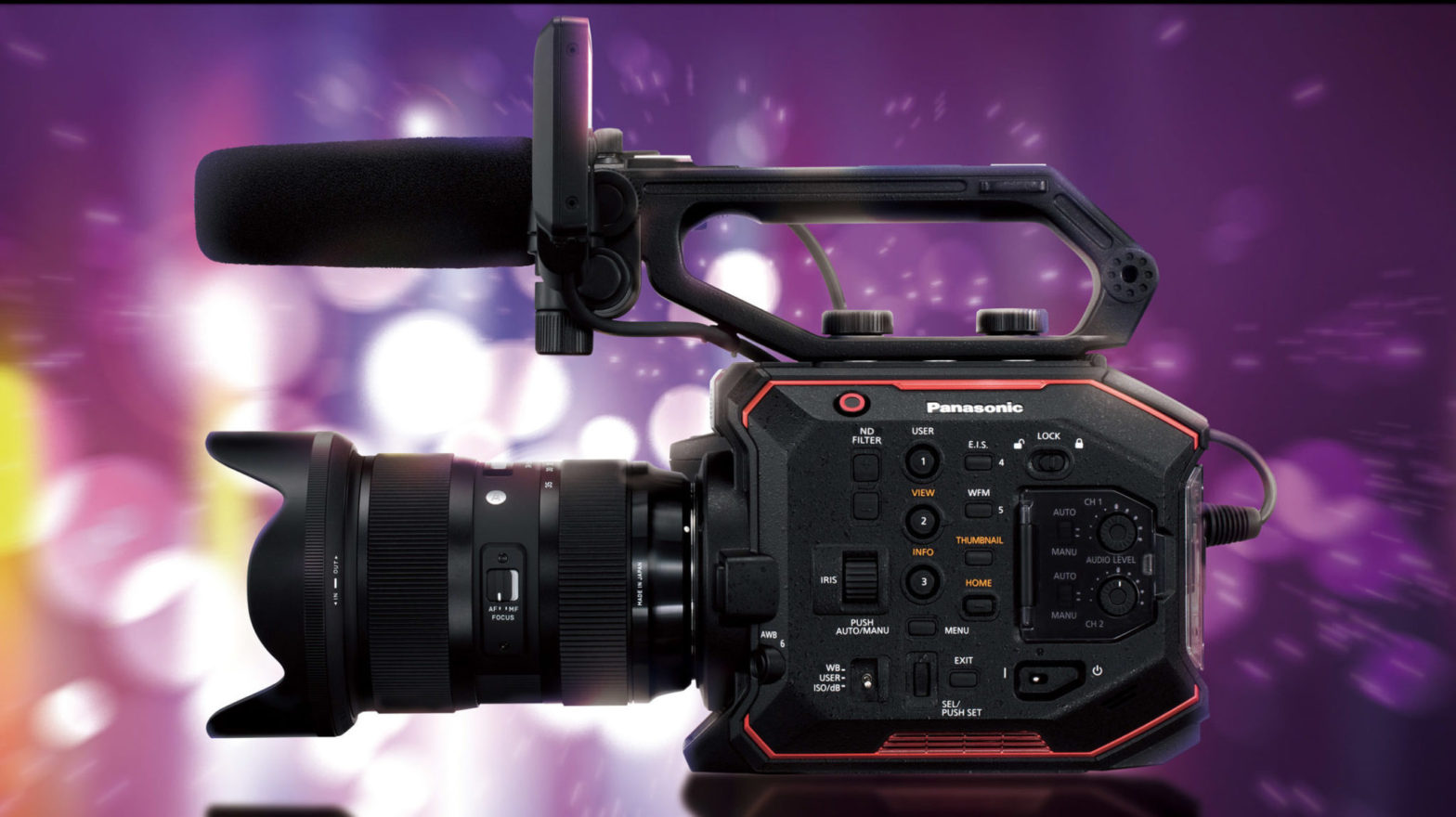
    EVA1 will feature Varicam colorimetry, proper V-Log and V-Gamut. It’s DCI 4K will be subsampled from a bran-new 5.7K Super 35 sensor, recording to an internal 10-bit 4:2:2 Intra codec at up to 400Mbps on SDXC cards (I will probably want to invest in the new V-class). It will also, eventually, output 5.7K raw over SDI and/or HDMI. It will work with DVX200 batteries. It will do 4K up to 60fps, as well as 2K up to 240fps. Still being tweaked, EVA1 will have some flavor of dual native ISO, probably close to Varicam LT’s settings of 800 and 5000. It has built-in ND, EIS, and a swing-away IR cut filter. The top handle, LCD, and side grip, are removable and repositionable. It also sports an active EF lens mount that most likely will be able to communicate with most fly-by-wire EF lenses and be able to control them with buttons on the camera body for iris and auto focus, if you’re into that sort of thing. Also, EVA1 is not bad to look at. The button layout is nice and the black-with-red-trim motif is sexy.

    My teeny-tiny complaint is that the EF mount is not a positive-locking one. Would that keep me from favoring EVA1 over, say, Blackmagic’s Ursa Mini Pro? Nope. Not at all. In fact, the only thing BMUMP has going for it now is it’s interchangeable mount system. That’s about it. Every other tick goes in EVA1’s favor. With the EF-mount, I will be able to utilize my set of SLR Magic APO Hyperprime Cine T2.1 25/50/85mm PL-mount lenses as I have a lovely EF-PL adapter that works extremely well. As I am also a stills photographer who uses Canon equipment, EVA1 should work beautifully with my little collection of medium-fast EOS “L” zoom lenses.

    EVA1’s price, which Panasonic says will be ‘under $8,000’, is enticing. Ursa Mini Pro’s price ($5,995), plus Shoulder Mount Kit ($395), 256GB Cfast2 card ($580), V-mount battery plate ($95), and a 14.8V 95Wh battery ($247), comes in at a bit more than $7,311 as a working system. “Under $8,000” could literally mean “$7,999,” but everything in the box is what I’d need. All I have to buy at that point is a few V90 SDXC cards which are far less expensive than Cfast2 cards. The batteries I already use with DVX200 will work for EVA1, as will my custom shoulder mount kit I slapped together with components from SmallRig and Zacuto.

    Speaking of “competition”, Canon recently announced it’s new EOS C200. Basically an 8-bit 4:2:0 35Mbps camcorder that primarily shoots 4K in a compressed version of Canon’s proprietary raw format, utilizing the EOS C700 sensor, at a measly 150Mbps. The lackluster announcement was, for me, a momentary diversion for a product which I don’t find appealing. Later, Sony announced they had a thousand personnel working on a new 135-format (“full frame”) sensor CineAlta that’ll come out at some point in a few years, be really expensive, and will prove to be a PITA to pull focus on.

    No thanks.

    It’s also no small thing that EVA1 is petite: less than 7″ long, and less than 6″ wide and tall. She also weighs less than 3lbs. She’s pretty much perfect for jib and stabilizer work, as well as being outfitted for heavier rig work, but with a total rig weight of “not very much” since EVA1 already is light as a feather. A few extra pounds won’t make a lot of difference, I don’t think. I’m sure she’ll be quite strong as I’ve always been impressed with Panasonic’s build quality. To put it bluntly (and to echo a joke from the movie “Airplane”), I like my cameras the way I like my women: petite, smart, strong, and black…with red trim. Joking aside, I think EVA1 is an absolute winner.

    A few niggles: it’s unclear at this point what the exact dual native ISO specs will be. We also have no idea what the new sensor’s dynamic range will be, or if AU-EVA1’s image quality will be anywhere near par to the AU’s sister Varicam line. We also don’t know what the actual MSRP or street price will be. Some other people are very interested in EVA1’s ability to auto focus with EF lenses, as well as what it’s OIS compatibility will be. I’m not personally interested in either of these functions, so it’s not really a thing, but some people are concerned so, for them, it’s worth mentioning. What is of concern to me is how the internal codecs will all play with each other, as well as what sort of sensor cropping are we looking at depending on codec, recording format, frame rates, etc. But, these are all little things that Panasonic is tweaking and will disclose in full before the camera ships this fall. Again, I’d prefer a locking EF mount, but having a bayonet version is not a deal breaker.

    Is the Panasonic AU-EVA1 my next cinema camera? I believe EVA1 could be a stellar addition to my small family of motion picture cameras, partially retiring my Blackmagic Cinema Camera, and allowing my Panasonic AG-DVX200 to focus on what it does best: reality/ENG work. It would be my intent for EVA1 to handle the TVCs, music videos, shorts, and feature films that come my way. I can’t wait to see what EVA1’s official specs will be when they are announced later this year. Panasonic says EVA1 is on track to be released by the end of 2017. I still need to see footage to be sure, but I’m looking forward to holding her in my hands soon and seeing what she’s made of. That’s when I’ll really know.

    Resources:
    http://business.panasonic.com/AU-EVA1.html
    http://business.panasonic.co.uk/professional-camera/camcorders/AU-EVA1-cinema-compact-camera-for-cinematic-moments
    http://pro-av.panasonic.net/en/eva1/index.html

  • Panasonic’s “Next Camera”

    Panasonic’s “Next Camera”

    There is only speculation at this point. Panasonic has announced a new cinema camera at NAB Show 2017 this week. However, that’s all anyone really knows. There are exactly zero details about the camera released by Panasonic during the tease. Panasonic representatives on the NAB Show floor have offered only scanty hints of what this new camera is all about.

    A mock-up of the new camera rests under veil within a thick glass case at the Panasonic booth at NAB Show between the new GH5 and the current Varicam line-up of LT, 35, and Pure. This suggests a camera that fills that void, offering more capability than the GH5, a stills camera, but not as robust (or expensive) as the Varicam LT. The bullet points above the veiled prop admit the camera is “small and light,” has “cinematic imagery,” will feature “low-cost media, workflow,” and will be “available Fall 2017.” That’s it. When asked what to call this new mystery camera, Mitch Gross, Panasonic North America’s Cinema Product Manager, during an interview stated simply it is Panasonic’s “next camera.”

    How soon until the full reveal? Thankfully, that will come the first week of June at Cine Gear Expo in Los Angeles, only five weeks away.

    Personally, I have been dreaming of a successor to the venerable, yet under-appreciated, AF100 from 2010. Being an owner/operator of DVX200, I am in love with the fixed-lens camcorder for video projects and some cinema-style work such as TV commercials and music videos. However, the DVX200’s biggest advantage is also it’s biggest obstacle: the fixed lens. It’s a great lens, but having a uni-body camcorder means I never will have the option to use something else. I’m stuck with that lens. Don’t get me wrong: it’s actually wonderful to never worry about changing lenses, carrying those lenses with me everywhere, risking dropping them during a change, dirtying up the sensor, and other things; but, man, it sure is nice to change lenses sometimes.

    For the majority of my work over the past few years has been reality in-nature. I’ve shot a lot of corporate videos, event videos, wedding videos, interviews, news segments, et cetera. Before I purchased DVX200, I was using my current cinema camera, the Blackmagic Cinema Camera 2.5K EF which I purchased in 2013. Also, a great camera, but hell to use in a reality situation. The cage and rigging makes it bulky and heavy, the lenses need to be changed. There’s no ND wheel. White balancing is a chore. Audio has to be recorded externally, and there’s a big brick battery lazily affixed to the cage. It’s fine for a controlled set, but daunting when covering an event; something that only happens once.

    With DVX200, since May of last year, I’ve only shot a few projects with the Blackmagic Cinema Camera as the majority of my work has been videography. 2016 was also the year I finally purchased a set of proper cinema lenses: the PL-mount SLR Magic APO Hyperprimes. Now, I need to start looking at upgrading my cinema camera. Lately, I have been eyeing the Blackmagic Ursa Mini Pro. However, I most likely will not be in a position ready-to-buy until end of the year. With Panasonic’s tease of a new cinema camera that just might be a spiritual successor to the AF100, or a straight-up AF200, my interest is piqued.

    Panasonic Pro Europe posted this to their Instagram account.

    I left the following comment:

    So, I’m going to go out on a limb and guess it’s [basically] an AF200: DVX200 body and features, m4/3 lens mount (with Super 35 sensor?), internal 10-bit 4:2:2 ProRes (please!) up to DCI 4K, and that flipping LCD has a snap-on loupe. I imagine it’d actually be the same 4/3″ sensor in the GH5. Not a Varicam, but would play well with V-log L. 13 stops of dynamic range? Probably aiming to compete with FS5 and 7, and C100-300. Might even be a non-raw competitor to Ursa Mini, and if it’s priced lower, all bets are off. Whatever this thing is, I am excited. We’ll know at Cine Gear Expo…

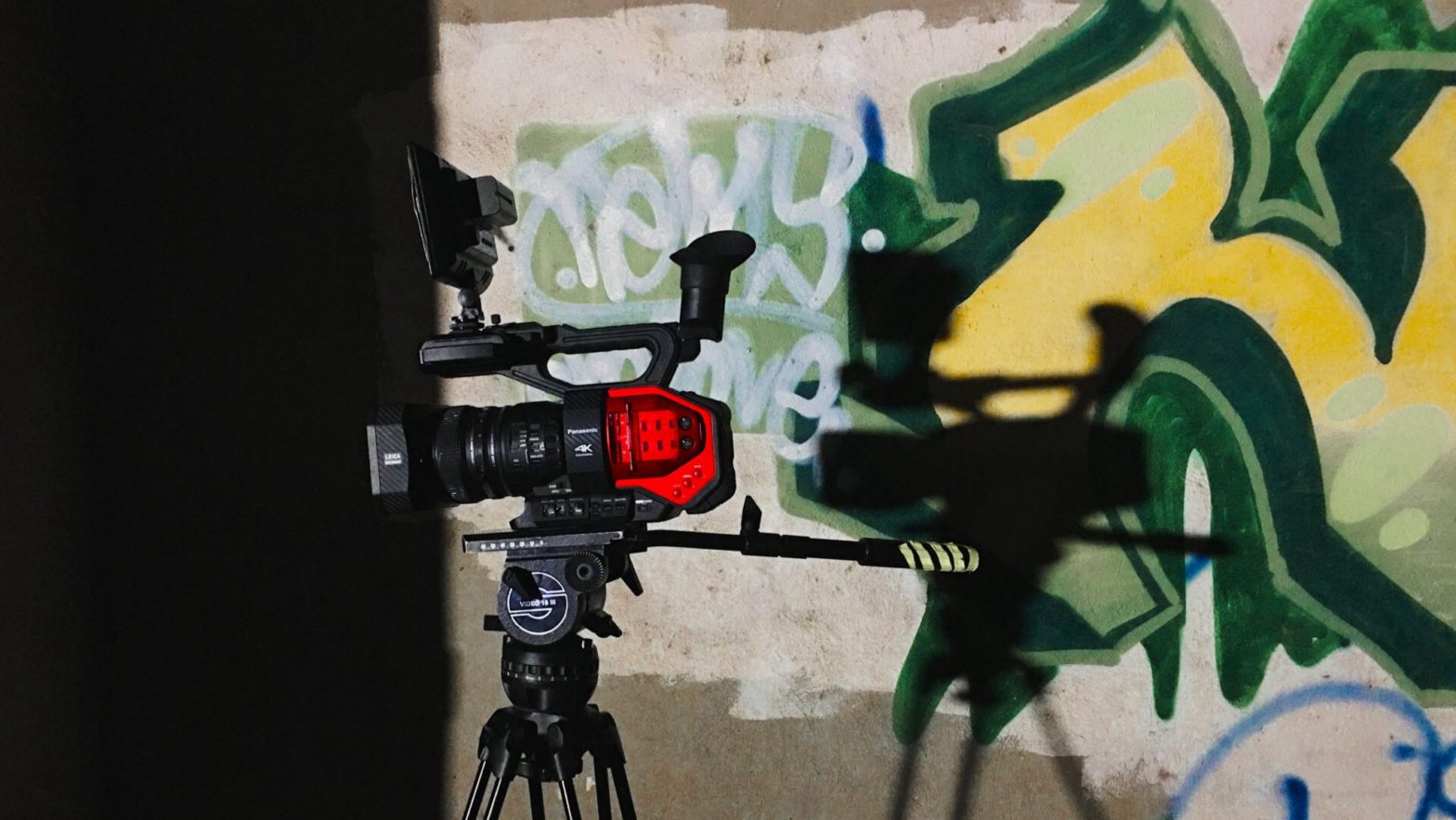
    Looking at the lens in the silhouette image, it is definitely a Sigma 24-35mm F2 DG HSM Art. I’m going to venture that is a fixed EF mount. I would imagine it is a M4/3 sensor, however, Panasonic might be alright with letting us have a Super 35 sensor. It’s not going to be a Varicam. It’s going to be a spiritual successor to the AF100 (or, the AF200). It has the same silhouette as the DVX200, minus the rear EVF and affixed lens. AF100 was basically an HVX200 body. This seems like the logical progression of things. It took forever for a successor to DVX100, and it was announced in 2015. I think this would make sense to announce an AF100 successor (again, either spiritually or a literal AF200), that would share the concept of the DVX200, but with an interchangeable lens and, hopefully, better internal codecs. Has anyone noticed that the LCD swivels horizontally (yaw roll)? That, by itself, is exciting.

    Personally, I’d love an Ursa Mini Pro…unless something better comes along at the same or better price when I’m ready to buy. And, technically, i am doing just fine with my current cameras so I don’t want to upgrade my cinema camera until I can afford to do so, and with a product I know will serve mine and my clients’ needs. But, I have a cinema camera. I needed to upgrade the video camera I bought in 2010, so I bought the DVX200 (again, I would LOVE a cinema camera in a DVX200 body). Then I needed cinema glass, and then a nicer field audio recorder, etc. Late 2017/early 2018, I’m looking to upgrade the cinema camera I bought in 2013. Ursa Mini Pro has been the top contender. Who knows about this new Panasonic? I like Panasonic very, very much. So, even if it doesn’t do internal raw, if everything else is very strong, my choice could definitely go in Panasonic’s direction.

    Meanwhile, user Osslund on DVXuser posted the following rumor yesterday:

    Just got this info about the new camera. It will have a S35 sensor and 14 stops of dynamic range. 4k up to 60fps. 1080p up to 120fps. All the usual stuff like ND, SDI/HDMI out. The body is very light weight at about 1 kg. Media used will be SDXC cards with dual slot capacity.

    The camera pars [sic] can be broken down and the shape of the camera is a mix of C100 and FS5. As is the price in the league of a C100 mkII.

    If even parts of that are actually correct, Panasonic’s “next camera” could very well be an Ursa Mini Pro killer for me. Regardless, the prospect of an “AF200” is super exciting. Too bad I can’t be in Las Vegas this week to try and peak through the cloth.