Category: News

  • In Anticipation of RED KOMODO

    In Anticipation of RED KOMODO

    I always wanted a RED.

    The RED Digital Cinema name has always been synonymous with the rugged, albeit wealthy, independent filmmaker life. Since founder Jim Jannard’s original RED ONE left their Irvine, California factory floor in 2007, the studio system has begun to take the RED name seriously. Today, more and more Hollywood films are Shot On RED™ — as the branding goes — than ever before, and more and more studio directors — such as David Fincher, Steven Soderbergh, and Terrence Malick — use them extensively or almost exclusively.

    For years, RED has been giving the established brands of Arri, Panavision, CineAlta (Sony), and Varicam (Panasonic), a run for their cine business, but they’ve also had their eyes on the prosumer market from the beginning. Back before SCARLET, RED had envisioned “4K for $4K”, a feat which didn’t exactly come true when SCARLET came along. The brain simply wouldn’t work without a lot of extra stuff that made the price tag go way, way up.

    Today, RED has finally achieved something in a similarly catchy way: “6K for $6K.” The RED KOMODO is effectively a 6K mini RED DRAGON that actually works right out of the box at $5,995. Users who would be most interested in KOMODO, probably, are Canon C-Series owners who would already own Canon EF or RF lenses, a few CFast cards and Canon BP-9xx-class batteries. RED also offers a couple of kits to help fresh-starters (like me) who are not already committed to the Canon line. I’m up in the air about either the Starter Pack or Production Pack.

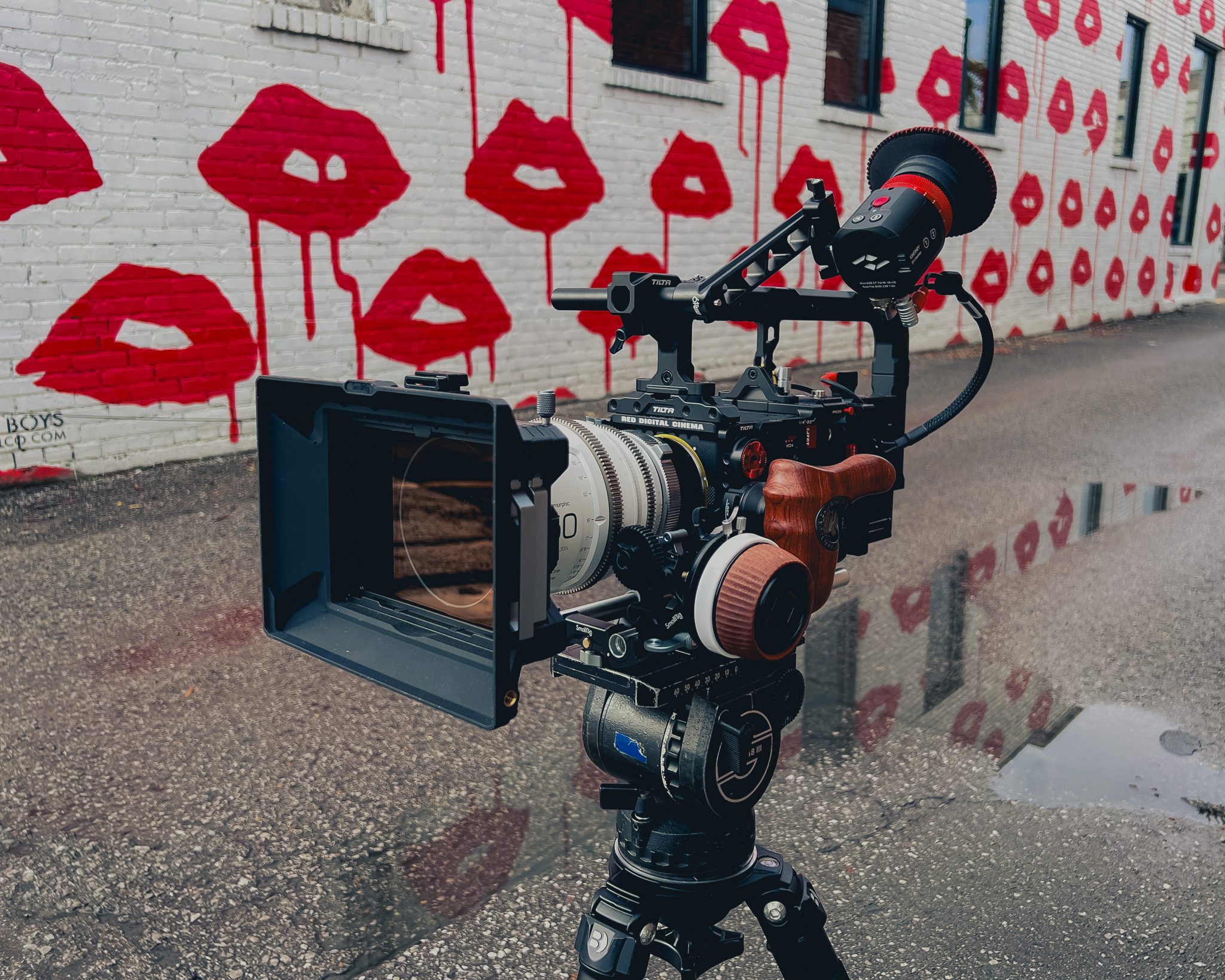
    KOMODO is the newest entrant and the latest innovation in the RED family of cinema cameras. Not only does it boast a shockingly small form-factor along with a 6K global shutter sensor, but also allows users to take advantage of a versatile RF mount for maximum lens choice flexibility and the latest evolution of RED’s REDCODE RAW Codec. The KOMODO also features a high-resolution touchscreen for navigating menus and reviewing footage, phase-detect auto-focus, 4K output, and compatibility with the all new RED CONTROL app for wired or wireless control.

    RED’s official statement regarding KOMODO
    I like boxy.

    Sensor

    RED KOMODO has a brand new 19.9 MP Super 35 CMOS sensor, called KOMODO, that features a global shutter. That global shutter alone is worth the price tag. Nothing says “not very cinematic” more than a great-looking image marred by the jello typical of rolling shutter cameras. KOMODO, a proper cinema camera, doesn’t do that. No bent helicopter blades, no skewed telephone polls, no more warbly whip-pans, and no more Jellyvision on digitally stabilized footage.

    Also of note is the reported visual dynamic range of 16+ stops.

    RED’s Image Processing Pipeline (IPP2) color management is very easy to work with, and I’m looking forward to actually finally owning a RED so I can really dive into it their color science. I like the way RED handles shadow detail when properly exposed.

    REDCODE

    Also exciting is the ability to shoot 2.4:1 at 48 fps in 6K using REDCODE MQ.

    KOMODO’s R3D settings come in three different flavors: HQ, MQ, and LQ. HQ (High Quality) is for VFX, extreme-detailed scenes, and stills from motion. MQ is for non-VFX cinema and high-end TV. The lowest setting, LQ, is for TV, online content, docs, interviews, and long takes. I would mostly use MQ which would give me 48 mins on a 512 CFast 2.0 card.

    The majority of my music videos, and slow-mo narrative work, are shot for 2.4:1 at 48fps in 4K on my FS7M2, which maxes out at 240 Mb (megabits) per second for a 24p base frame rate. KOMODO maxes out at 280 MB (megabytes) per second, which means a gargantuan difference in image detail. Remember: 1 byte is worth 8 bits. Yuge.

    If I need it, KOMODO will do 120 fps at 2K 17:9. It also has ProRes 422 HQ for quick 4K and 2K work.

    Lens Mount

    KOMODO uses a non-changeable Canon RF lens mount, the newest from the esteemed Japanese camera manufacturer, intended to compete against other manufacturers’ electronic bayonet lens mounts for mirrorless cameras. KOMODO will ship with an RF-EF adapter for those of us who use EF lenses (I do: as a stills photographer I use Canon EF bodies and lenses). KOMODO’s RF mount unfortunately does not have a positive-locking function, however, adapters for EF and PL (I’m interested in PL) often come with a foot used to affix the adapter to the same plate the camera is. This prevents unwanted rotation of the adapter during focus pulls. I am highly interested in the Revolva RF/PL adapter by Kippertie.

    There are also RF-EF adapter options that feature “speedboosters” which would allow the KOMODO’s Super 35 sensor to behave as a 135 format sensor for “full frame” EF lenses, as mine are. My PL mount SLR Magic APO Hyperprime cine lenses are also rated for 6K “full frame” sensors. Perhaps there will be a RF-PL speedbooster one day.

    Power

    For Canon C-series guys, KOMODO will accept their BP-9xx batteries. For me, I prefer my V-mount bricks. They work extremely well on my FS7M2 and I’d want all their benefits for my future KOMODO. Therefore, I am very interested in the V-mount plate for RED KOMODO by Core SWX.

    Rigging

    I am confidant my existing collection of rigging will work for KOMODO, however I am considering KOMODO-specific rigging from Tilta. Because of the Kippertie Revolva with chinstrap to nullify unwanted lens rotation, the sides of the KOMODO near the lens will be occupied. I am interested in the Tilta accessories Top Plate ($15), QR Top Handle ($59), and Adjustable Cold Shoe Mounting Bracket ($26) for KOMODO. This kit equals $100 in total.

    Costs

    RED KOMODO body: $5,995
    RED CFast 2.0 512 MB card: $529
    RED CFast 2.0 card reader: $110
    Core SWX V-mount battery plate: $199
    Tilta rigging kit: $100
    Kippertie Revolva RF/PL + chinstrap, and cartridges A & B: £1,830.00 ($2,545)

    Total (not including shipping or tax): $9,478

    KOMODO vs FS7 Mark II

    Not a fair comparison as they are different cameras intended for different purposes, but I do own an FS7M2 which does 99.9% of my work and has paid for itself many times over.

    I am very happy with my FS7M2. However, there are times I wish it’s image weren’t so noisy in the shadows, I wish it’s native color science was a bit more reminiscent of film, I wish it’s highlight rolloff was more gradual, and I wish it did not have a rolling shutter. I also wish it did 6K for very nice looking 4K, like FX9 or EVA1 does. For docs and interviews and other broadcast/reality work, FS7 is amazing. It does a great job pretending to be a cinema camera, but no matter how good the image is, it occasionally just looks like video.

    KOMODO vs FX9

    I am still extremely interested in FX9 to replace my FS7 as A camera. FX9 is a Swiss Army Knife of a camera and certainly better suits my filming style as far as being the camera I use for everything. KOMODO would not be used for reality and documentary work, but FX9 most certainly could and would. FX9 has a ton going for it, but there’s something about owning a RED that would also, conceivably, put more food on my plate.

    Owning both FX9 and KOMODO would be the optimum solution, of course – both cameras would give me 6K, and the KOMODO would certainly be used on higher-end work, whereas the FX9 would be more of a run-and-gun tool. Again, FS7 would be demoted to B camera (or C if filming with KOMODO and FX9) in that scenario.

    Conclusions

    The ability to acquire footage in true 6K for extremely clean 4K or 2K, with a global shutter, and RED’s cinematic color science, is very appealing to me.

    KOMODO is pretty exciting. I’ve used RED ONE, RED SCARLET, RED EPIC, and RED RAVEN, but never owned any. With KOMODO, RED has finally made a camera accessibly-priced for professionals in my tier, but hasn’t watered down the name in favor of mass appeal. People who suck at cinematography on an iPhone will still suck at it with a KOMODO, or an EPIC.

    KOMODO is literally intended as a B-cam or crash cam for the more expensive RED cameras. Since I have a lot of experience working with RED, KOMODO will be a walk-in-the-park for me, and a breath of fresh air as far as image quality goes. The ability to acquire footage in true 6K for extremely clean 4K or 2K, with a global shutter, and RED’s cinematic color science, is very appealing to me.

    If I do decide to buy a KOMODO, it will be my first personally-owned RED camera. It would be what I use for high-end work including narrative films, TV commercials, and music videos, replacing my FS7M2 in that capacity, but would also serve as a B-camera on multicam gigs with FS7M2. Although the waitlist is somewhere around 3 months, I’m definitely looking forward to possibly owning a RED KOMODO soon.

    Update: I purchased my Komodo October 7, 2022, receiving it October 10.

  • I’m In Love With The Sony FX9

    I’m In Love With The Sony FX9

    Looking for a companion for my FS7M2, I’m giddy with excitement about Sony’s upcoming “full-frame” camera.

    Cameras are my thing, but they don’t always impress me. The last quasi ten-thousand dollar camera that did impress me was Sony’s PXW-FS7 Mark 2. Even the first version of FS7 did not hold my interest, but the Mark 2’s additions of a locking-lever E mount and electronic variable ND made me reconsider the line. I reconsidered it so much that I eventually bought my own.

    Ahead of IBC 2019 earlier this month, Sony announced a new line of XDCAM 4K camera nudged between the FS7 and their flagship large format 6K CineAlta VENICE, the PXW-FX9, and it is a beast.

    Sony PXW-FX9

    The Chewy Outside

    As an owner/operator of the FS7M2, I am already very comfortable with the layout of the FX9. I’m a fan of buttons and this new camera has a ton of them; several of which are customizable. I appreciate how there are now buttons for switching through the filter presets, the headphone volume controls, and the Playstation-style controller for navigating the menus.

    Many FS7-compatible accessories will work with FX9 as both cameras share similar spec on the top and bottom. The FX9’s top handle actually looks like the exact same one from the FS7M2! Speaking of compatibility: the FX9 uses the XAVC-I codec so the internal recording media are the exact same XQD cards that work with FS7. Speaking of recording footage: the SD card slot which is used by FS7 only for saving configuration data, is capable of recording proxies on FX9. Very sweet.

    One of the things I am very happy about is Sony’s locking-lever E mount makes a return. It was such a clever addition to the FS7M2 that it made its way into the flagship VENICE camera and now here it is in the new FX9. I don’t think it’s going anywhere any time soon, and that’s a good thing. Anyone complaining about needing two hands to change a lens are stills photographers who pine for wobbly bayonet lens mounts and have probably never worked with proper cine lenses.

    Some other nice bits that lift FX9 above FS7 are the new 1080p viewfinder, TC in/out and genlock without need of an extension unit, improved ergonomics, beefier build quality, and the world’s first “full frame” electronic variable ND which gives you filtration from 2 to 7 stops with nearly step-less transitions. One of the little things about the ND is there is now a glass element at the Clear setting so the back focus isn’t thrown out of whack. Neat!

    Sony PXW-FX9

    The Creamy Filling

    But the juicy parts are what’s on the inside.

    The 6K oversampled “full frame” back-illuminated Exmor R 35.7 x 18.8mm CMOS sensor packs more than 15 stops of latitude, features dual native ISO of 800/4000, and inherits the S-Cinetone color science from the VENICE digital motion picture camera. The sensor downsamples its 6K image for a very sharp, true 4K image. FX9 will do 120 fps in FHD from 2K FF at launch, and with a future firmware update will be able to record 4K up to 60 fps from a 5K mode, and FHD will eventually go up to 180 fps. With an XDCA-FX9 extension module, the FX9 will output 16 bit raw.

    The dual native ISO is very exciting to me as it means FX9 allegedly has a much cleaner image than FS7’s very noisy one. The FX9’s native 4000 ISO is cleaner than the FS7’s native 2000. With my FS7M2 I always get a cleaner image when I record around ISO 1000. That cleaner image (from the oversampled, larger sensor) at 1.5 stops greater sensitivity than the FS7’s cleaner 1000 ISO means the FX9 will have a nearly noiseless image in very difficult lighting environments over FS7. That’s great for filming in a variety of documentary situations. When you don’t need the extra light sensitivity, you can switch over to base ISO 800 and limit the need for ND greater than 1/128 (ND 2.1).

    There is also enhanced Fast Hybrid Auto Focus that will work (and apparently extremely well) with E mount lenses such as the SELP28135G. I’m not a fan of AF while recording, but the videos I’ve seen so far online have been making me reconsider for certain jobs. Also, is the built-in gyro which records meta information that can be read by Catalyst Browse or Catalyst Prepare software and used to digitally stabilize the footage, a feature which Sony hopes third parties will add to their NLE’s. I’m looking at you, Apple. Of some interest is the fact that the FX9 features 5GHz and 2.4GHz Wi-Fi to remotely transfer footage or control the camera.

    Also of note is the upcoming FE C line of “full frame” E mount cine lenses. First one out of the gate in Spring 2020 is the FE C 16-35mm T3.1 G. Designed to be both for auto focus servo zoom documentary work, and fully manual cine work, these new lenses look like they’ll work extremely well with both FX9 and VENICE.

    Conclusions

    I believe the Sony PXW-FX9 will make a great companion to my PXW-FS7M2. I think the FX9’s large format juiciness could be the cinematic big brother to the FS7’s Super 35 reality and documentary style, while complementing each other well on multi-cam projects. I’m looking forward to Sony fulfilling the FX9’s firmware roadmap and seeing how the camera matures over the next several months upon its release at the end of 2019.

    Here is a list of other websites where you can research the FX9 yourself.

    In case you’re wondering, I dislike the term “full frame” when discussing 135 Format or VistaVision-sized sensors. It’s meaningless Canon 5D marketing speak and makes zero sense at all. Thus, I put the annoying term in quotations because I’d be making air ones if I were to speak the term in person. Unfortunately, the term has found its way into the popular lexicon and it doesn’t look like it’s going away any time soon.

  • Blackmagic Pocket Cinema Camera 6K Announced

    Blackmagic Pocket Cinema Camera 6K Announced

    A 6K, Super 35, BRAW, EF lens mount, tiny little powerhouse.

    Last April, Blackmagic Design announced the 4K Micro 4/3″ update to their popular Super 16 Pocket Cinema Camera. This month, Blackmagic has announced the 6K version upgraded with a Super 35 sensor and a bayonet EF lens mount. The new camera records Blackmagic RAW for full sensor and windowed sensor formats, as well as different flavors of ProRes for scaled formats. Using BRAW the Pocket 6K records 6K, 6K 2.40:1 (Cinemascope), 5.7K and 2.8K 17:9, plus 3.7K anamorphic.

    My gripe is with the EF mount. Sure, we’re stuck with EF because that’s the mount of choice for a lot of photographers-turned-cinematographers and the Pocket Cinema Camera line is directly aimed at that demographic. Why use your Canon DSLR when you can use a proper video camera? It makes business sense, and I get it. It’s just too bad because I would have preferred at least a locking-lever EF mount to prevent wobble whilst racking focus or zoom. Of course, a user-replaceable mount would have been ideal, but I’m sure Blackmagic doesn’t want the Pocket to compete with their own Ursa Mini line.

    I opined that the Pocket 4K was a winner last year. My thoughts on the upgraded 6K version are the same, albeit with shallower depth of field. I wound up not purchasing a Pocket 4K, and I might not purchase a 6K, either, but I do think Blackmagic aiming for an affordable, tiny, 6K Super 35 camera that records raw internally, priced around $2,500 USD, is one hell of an industry-disrupting move. This will undoubtedly force the other digital motion picture camera manufacturers to change some of their upcoming plans.

  • Blackmagic Pocket Cinema Camera 4K Announced

    Blackmagic Pocket Cinema Camera 4K Announced

    Blackmagic Design unveiled the update to their popular Pocket Cinema Camera at NAB Show 2018 this week, and the little camera looks like a winner.

    The spec on the Blackmagic Pocket Cinema Camera 4K looks fantastic on paper! 13 stops visual dynamic range, dual native ISO (400/3200), sensitivity up to ISO 25600, 5″ touchscreen (featuring the lovely user interface introduced with the Camera 4.0 OS update in October 2016), DCI 4K and UHD up to 60fps, windowed FHD up to 120fps, HDMI-A, USB-C, and 3D LUT support. It also supports ProRes from 422 HQ to 422 Proxy, as well as Cinema DNG and 3:1 and 4:1 lossless raw compression ratios.

    And it’s pretty.

    Powered by standard Canon LP-E6N batteries, Pocket 4K will accept SD/UHX II cards (which, I’m assuming, includes version 5 SDXC media with the new Video Speed Class), but you will need CFast 2.0 cards to enable all the camera’s frame rate and codec options. Also, it will ship with a full license for Davinci Resolve Studio which was recently updated to Version 15.

    The only thing I’m not completely in love with is the sensor not being Super 35 (it’s Four Thirds with an active Micro Four Thirds lens mount), but that’s such a tiny quibble. Everything else is superb, especially if looking at it from the perspective of an independent freelance video producer wanting to graduate from their digital single lens reflex (DSLR) camera, or mirrorless interchangeable lens camera (MILC) to a device that has a familiar form but has all the gooey insides of a proper digital film (read: video) camera.

    Speaking of which the Pocket 4K will also capture stills like a traditional DSLR. This is a cute reverse of the stills camera that also shoots video being that the Pocket 4K closely resembles the form factor of a DSLR or ML body. At this point I can only imagine stills would be captured as Cinema DNG raw up to DCI 4K (4096 x 2160) at either 12 or 14 bits with hopefully a DPI of something better than 200.

    It could be argued the Pocket 4K is the camera the original Blackmagic Cinema Camera 2.5K EF should have been (except that camera probably would have also been 2.5K in 2013). It’s definitely the camera I wish I’d bought from Blackmagic that year! I’m sure the image quality of Pocket 4K will be sublime; at least on par with the Blackmagic Cinema Camera or the original Pocket Cinema Camera. If it’s more like Ursa Mini Pro, that’d be terrific, too. Blackmagic Design says the camera will be embedded with all their color science.

    I can see Pocket 4K being used for quite a lot of projects including stills, especially if it plays well with Canon L glass. I might just have to buy one of these for myself come end of the year! The Blackmagic Pocket Cinema Camera 4K is expected to be released in September 2018.

  • My Next Camera Revealed

    My Next Camera Revealed

    After months of deliberation (and a bit of saving up), I finally decided on my next cinema camera. Upgrading from my old Blackmagic Cinema Camera 2.5K EF I purchased in 2013, plus some heavy lifting by the DVX200 and 6D, I felt it was time for a change.

    Considering all the types of digital video work I do, I am in need of a Swiss Army knife: a camera that can be used both for ENG and film-style work. A camera that feels just at home with a servo-zoom broadcast lens or a fast cine prime. A camera that can give me UHD at 4:2:2 10-bit with an Intra-frame codec at reasonable Mbps rates, but also give me an option for DCI 4K raw if I need it at a later time. A camera that works right out of the box without a lot of rigging. Plus, I do not want to be handicapped by a miniscule option of lens mounts.

    I decided on the Sony PXW-FS7M2.

    Here’s why.

    The main reason is the Lever Locking E-mount. That versatile mount sits in front of the same Super 35 sensor used in the F5 CineAlta, but in the more compact body of an enhanced FS7.

    Second reason is the incredible electronic ND with stepless intensity from two to seven stops of light reduction without perceptable color shifts or other degradation.

    Third reason is as much as I’d enjoy an EVA1, by the time I’ve purchased other bits to rig it up to the out-of-the-box level of an FS7, I might as well have purchased an FS7. Also, I feel the price difference between the FS7 and FS7M2, given that both items from the first two reasons above are both exclusively for the FS7M2, is a justifiable price for a worthwhile upgrade.

    Also, I believe the FS7M2 will provide a suitable platform for ‘future-proofing,’ including further customization and expansion such as cinema rigging, various lens mount adapters, monitoring, brick battery system integration, power and signal distribution systems, wireless video taps, and other modifications, all of which may be securely bolted into the system so it behaves as an integrated unit rather than a DIY ‘frankenrig’.

    Though I have long been vocal of my dislike for “Sony colors”, the FS7-series’ CineEI mode and the ability to view or bake in LUTs, has changed my mind. Even the classic Custom mode with it’s SLOG options and matrix flexibility have won me over in recent tests with the fully upgraded mark one FS7, particularly tweaks to match color between FS7 and Arri Amira. I believe FS7M2 is clearly a tool that is only as good as the human using it. I always look forward to using a tool that works just as hard as I do.

    I intend to purchase my Sony PXW-FS7M2 next week in Austin. Did someone say ‘roadtrip?’

  • What’s Inside the South Texas ISD TV Spots

    What’s Inside the South Texas ISD TV Spots

    A total of 28 video advertisements, 14 radio ads, 7 audio interviews, portrait photography, coordination of an entire magnet school district spread across 3 counties along the Rio Grande Valley of south Texas, with English and Spanish deliverables, running on broadcast television, and select Cinemark movie theaters. All tying in to a single website: insideSTISD.com. Another epic project I produced, wrote, and directed in collaboration with South Texas ISD.

  • Fujifilm X100F: Why I Love It

    Fujifilm X100F: Why I Love It

    If you read my blog and visit my website, you know I am a cinematographer and pro photographer. I have lots of cameras; my new X100F is only one of them. Film, digital, video, medium format, 135, APS, 1/6″, 1/3″, 2/3″, 1″, 4/3″, Super 16, DCI 4K, whatever the iPhone 7 Plus sensor is…and those are the ones I own. Lots of lenses and several types of lens mounts: some modern, some antique. I’ve been on shows where we rented Red Epic, Sony CineAlta, Panasonic Varicam, and others. Also, I’ve literally been in the business for 20 years. X100F only arrived at my doorstep yesterday, and it’s already become my favorite “every day” camera. I’ve never known a camera this small which packed this big a punch. I have never had a leaf shutter in a compact digital camera at this price. It is unreal.

    If you are merely an enthusiast and want to leave the world of heavy SLR cameras and interchangeable lens systems, then sell it all, buy a silver X100F, fancy brown leather case, a red soft shutter release button, a couple spare batteries, maybe the generation II wide and tele-converters, a fast 64GB SanDisk Extreme Pro card, and a nice vacation for you and the wife. Then take tons of lovely film-emulated photos of said vacation. You’ll be happy as a clam.

    If you’re a pro photog and need the interchangeable lens system and like the 135 format, then still get a X100F and build up to all the accessories.

    If you’re a pro and want interchangeable lenses but aren’t married to what plebians call “full frame”, then seriously consider selling your gear and investing into the current generation of Fujifilm cameras. The APS format is no slouch.

    My first X100F panorama, processed with VSCO’s C9 preset on my iPhone 7 Plus.

    It doesn’t matter if your primary format is medium or large, or if you’re a n00b who doesn’t know what the exposure triangle is or the difference between parfocal and varifocal, X100F is an amazing little camera. It is helping rekindle my burnt-out love for photography.

    6D, VSCO, C9

    I got my X100F yesterday. I’ve been a photographer for over half my life, but I had never really fallen in love with a camera system as I have with the X100 series. X100F was finally the one I decided was amazing enough to buy (the ISO dial, right-hand placement of buttons, and Acros film emulation clinched it for me) and I don’t regret a thing. For the first time in years, yesterday, as I was shooting my first tests, I found myself having fun. X100F is great.

    A quick selfie through the doorway. Processed with VSCO with c9 preset

    Get X100F if you want stellar image quality in a small camera body with precise tactile controls, regardless of what camera system you’re used to currently.

    I have zero qualms calling myself a pro with just X100F hanging around my neck.

  • Panasonic AU-EVA1; my next cinema camera?

    Panasonic AU-EVA1; my next cinema camera?

    The big preview of Panasonic’s newest cinema camera, seated comfortably between Varicam LT and GH5, happened at Cine Gear Expo in Los Angeles Friday afternoon. Introducing the Panasonic AU-EVA1. I am astounded at how many of my needs EVA1 checks off my list for a cinema camera upgrade. She also added a few things to the list I couldn’t have imagined I’d be able to personally afford in a new cinema camera. EVA1 winds up being a miniature Varicam LT, without the Varicam badge, price, or weight. The specs previewed so far are jaw-dropping.

    EVA1 will feature Varicam colorimetry, proper V-Log and V-Gamut. It’s DCI 4K will be subsampled from a bran-new 5.7K Super 35 sensor, recording to an internal 10-bit 4:2:2 Intra codec at up to 400Mbps on SDXC cards (I will probably want to invest in the new V-class). It will also, eventually, output 5.7K raw over SDI and/or HDMI. It will work with DVX200 batteries. It will do 4K up to 60fps, as well as 2K up to 240fps. Still being tweaked, EVA1 will have some flavor of dual native ISO, probably close to Varicam LT’s settings of 800 and 5000. It has built-in ND, EIS, and a swing-away IR cut filter. The top handle, LCD, and side grip, are removable and repositionable. It also sports an active EF lens mount that most likely will be able to communicate with most fly-by-wire EF lenses and be able to control them with buttons on the camera body for iris and auto focus, if you’re into that sort of thing. Also, EVA1 is not bad to look at. The button layout is nice and the black-with-red-trim motif is sexy.

    My teeny-tiny complaint is that the EF mount is not a positive-locking one. Would that keep me from favoring EVA1 over, say, Blackmagic’s Ursa Mini Pro? Nope. Not at all. In fact, the only thing BMUMP has going for it now is it’s interchangeable mount system. That’s about it. Every other tick goes in EVA1’s favor. With the EF-mount, I will be able to utilize my set of SLR Magic APO Hyperprime Cine T2.1 25/50/85mm PL-mount lenses as I have a lovely EF-PL adapter that works extremely well. As I am also a stills photographer who uses Canon equipment, EVA1 should work beautifully with my little collection of medium-fast EOS “L” zoom lenses.

    EVA1’s price, which Panasonic says will be ‘under $8,000’, is enticing. Ursa Mini Pro’s price ($5,995), plus Shoulder Mount Kit ($395), 256GB Cfast2 card ($580), V-mount battery plate ($95), and a 14.8V 95Wh battery ($247), comes in at a bit more than $7,311 as a working system. “Under $8,000” could literally mean “$7,999,” but everything in the box is what I’d need. All I have to buy at that point is a few V90 SDXC cards which are far less expensive than Cfast2 cards. The batteries I already use with DVX200 will work for EVA1, as will my custom shoulder mount kit I slapped together with components from SmallRig and Zacuto.

    Speaking of “competition”, Canon recently announced it’s new EOS C200. Basically an 8-bit 4:2:0 35Mbps camcorder that primarily shoots 4K in a compressed version of Canon’s proprietary raw format, utilizing the EOS C700 sensor, at a measly 150Mbps. The lackluster announcement was, for me, a momentary diversion for a product which I don’t find appealing. Later, Sony announced they had a thousand personnel working on a new 135-format (“full frame”) sensor CineAlta that’ll come out at some point in a few years, be really expensive, and will prove to be a PITA to pull focus on.

    No thanks.

    It’s also no small thing that EVA1 is petite: less than 7″ long, and less than 6″ wide and tall. She also weighs less than 3lbs. She’s pretty much perfect for jib and stabilizer work, as well as being outfitted for heavier rig work, but with a total rig weight of “not very much” since EVA1 already is light as a feather. A few extra pounds won’t make a lot of difference, I don’t think. I’m sure she’ll be quite strong as I’ve always been impressed with Panasonic’s build quality. To put it bluntly (and to echo a joke from the movie “Airplane”), I like my cameras the way I like my women: petite, smart, strong, and black…with red trim. Joking aside, I think EVA1 is an absolute winner.

    A few niggles: it’s unclear at this point what the exact dual native ISO specs will be. We also have no idea what the new sensor’s dynamic range will be, or if AU-EVA1’s image quality will be anywhere near par to the AU’s sister Varicam line. We also don’t know what the actual MSRP or street price will be. Some other people are very interested in EVA1’s ability to auto focus with EF lenses, as well as what it’s OIS compatibility will be. I’m not personally interested in either of these functions, so it’s not really a thing, but some people are concerned so, for them, it’s worth mentioning. What is of concern to me is how the internal codecs will all play with each other, as well as what sort of sensor cropping are we looking at depending on codec, recording format, frame rates, etc. But, these are all little things that Panasonic is tweaking and will disclose in full before the camera ships this fall. Again, I’d prefer a locking EF mount, but having a bayonet version is not a deal breaker.

    Is the Panasonic AU-EVA1 my next cinema camera? I believe EVA1 could be a stellar addition to my small family of motion picture cameras, partially retiring my Blackmagic Cinema Camera, and allowing my Panasonic AG-DVX200 to focus on what it does best: reality/ENG work. It would be my intent for EVA1 to handle the TVCs, music videos, shorts, and feature films that come my way. I can’t wait to see what EVA1’s official specs will be when they are announced later this year. Panasonic says EVA1 is on track to be released by the end of 2017. I still need to see footage to be sure, but I’m looking forward to holding her in my hands soon and seeing what she’s made of. That’s when I’ll really know.

    Resources:
    http://business.panasonic.com/AU-EVA1.html
    http://business.panasonic.co.uk/professional-camera/camcorders/AU-EVA1-cinema-compact-camera-for-cinematic-moments
    http://pro-av.panasonic.net/en/eva1/index.html

  • Panasonic’s “Next Camera”

    Panasonic’s “Next Camera”

    There is only speculation at this point. Panasonic has announced a new cinema camera at NAB Show 2017 this week. However, that’s all anyone really knows. There are exactly zero details about the camera released by Panasonic during the tease. Panasonic representatives on the NAB Show floor have offered only scanty hints of what this new camera is all about.

    A mock-up of the new camera rests under veil within a thick glass case at the Panasonic booth at NAB Show between the new GH5 and the current Varicam line-up of LT, 35, and Pure. This suggests a camera that fills that void, offering more capability than the GH5, a stills camera, but not as robust (or expensive) as the Varicam LT. The bullet points above the veiled prop admit the camera is “small and light,” has “cinematic imagery,” will feature “low-cost media, workflow,” and will be “available Fall 2017.” That’s it. When asked what to call this new mystery camera, Mitch Gross, Panasonic North America’s Cinema Product Manager, during an interview stated simply it is Panasonic’s “next camera.”

    How soon until the full reveal? Thankfully, that will come the first week of June at Cine Gear Expo in Los Angeles, only five weeks away.

    Personally, I have been dreaming of a successor to the venerable, yet under-appreciated, AF100 from 2010. Being an owner/operator of DVX200, I am in love with the fixed-lens camcorder for video projects and some cinema-style work such as TV commercials and music videos. However, the DVX200’s biggest advantage is also it’s biggest obstacle: the fixed lens. It’s a great lens, but having a uni-body camcorder means I never will have the option to use something else. I’m stuck with that lens. Don’t get me wrong: it’s actually wonderful to never worry about changing lenses, carrying those lenses with me everywhere, risking dropping them during a change, dirtying up the sensor, and other things; but, man, it sure is nice to change lenses sometimes.

    For the majority of my work over the past few years has been reality in-nature. I’ve shot a lot of corporate videos, event videos, wedding videos, interviews, news segments, et cetera. Before I purchased DVX200, I was using my current cinema camera, the Blackmagic Cinema Camera 2.5K EF which I purchased in 2013. Also, a great camera, but hell to use in a reality situation. The cage and rigging makes it bulky and heavy, the lenses need to be changed. There’s no ND wheel. White balancing is a chore. Audio has to be recorded externally, and there’s a big brick battery lazily affixed to the cage. It’s fine for a controlled set, but daunting when covering an event; something that only happens once.

    With DVX200, since May of last year, I’ve only shot a few projects with the Blackmagic Cinema Camera as the majority of my work has been videography. 2016 was also the year I finally purchased a set of proper cinema lenses: the PL-mount SLR Magic APO Hyperprimes. Now, I need to start looking at upgrading my cinema camera. Lately, I have been eyeing the Blackmagic Ursa Mini Pro. However, I most likely will not be in a position ready-to-buy until end of the year. With Panasonic’s tease of a new cinema camera that just might be a spiritual successor to the AF100, or a straight-up AF200, my interest is piqued.

    Panasonic Pro Europe posted this to their Instagram account.

    I left the following comment:

    So, I’m going to go out on a limb and guess it’s [basically] an AF200: DVX200 body and features, m4/3 lens mount (with Super 35 sensor?), internal 10-bit 4:2:2 ProRes (please!) up to DCI 4K, and that flipping LCD has a snap-on loupe. I imagine it’d actually be the same 4/3″ sensor in the GH5. Not a Varicam, but would play well with V-log L. 13 stops of dynamic range? Probably aiming to compete with FS5 and 7, and C100-300. Might even be a non-raw competitor to Ursa Mini, and if it’s priced lower, all bets are off. Whatever this thing is, I am excited. We’ll know at Cine Gear Expo…

    Looking at the lens in the silhouette image, it is definitely a Sigma 24-35mm F2 DG HSM Art. I’m going to venture that is a fixed EF mount. I would imagine it is a M4/3 sensor, however, Panasonic might be alright with letting us have a Super 35 sensor. It’s not going to be a Varicam. It’s going to be a spiritual successor to the AF100 (or, the AF200). It has the same silhouette as the DVX200, minus the rear EVF and affixed lens. AF100 was basically an HVX200 body. This seems like the logical progression of things. It took forever for a successor to DVX100, and it was announced in 2015. I think this would make sense to announce an AF100 successor (again, either spiritually or a literal AF200), that would share the concept of the DVX200, but with an interchangeable lens and, hopefully, better internal codecs. Has anyone noticed that the LCD swivels horizontally (yaw roll)? That, by itself, is exciting.

    Personally, I’d love an Ursa Mini Pro…unless something better comes along at the same or better price when I’m ready to buy. And, technically, i am doing just fine with my current cameras so I don’t want to upgrade my cinema camera until I can afford to do so, and with a product I know will serve mine and my clients’ needs. But, I have a cinema camera. I needed to upgrade the video camera I bought in 2010, so I bought the DVX200 (again, I would LOVE a cinema camera in a DVX200 body). Then I needed cinema glass, and then a nicer field audio recorder, etc. Late 2017/early 2018, I’m looking to upgrade the cinema camera I bought in 2013. Ursa Mini Pro has been the top contender. Who knows about this new Panasonic? I like Panasonic very, very much. So, even if it doesn’t do internal raw, if everything else is very strong, my choice could definitely go in Panasonic’s direction.

    Meanwhile, user Osslund on DVXuser posted the following rumor yesterday:

    Just got this info about the new camera. It will have a S35 sensor and 14 stops of dynamic range. 4k up to 60fps. 1080p up to 120fps. All the usual stuff like ND, SDI/HDMI out. The body is very light weight at about 1 kg. Media used will be SDXC cards with dual slot capacity.

    The camera pars [sic] can be broken down and the shape of the camera is a mix of C100 and FS5. As is the price in the league of a C100 mkII.

    If even parts of that are actually correct, Panasonic’s “next camera” could very well be an Ursa Mini Pro killer for me. Regardless, the prospect of an “AF200” is super exciting. Too bad I can’t be in Las Vegas this week to try and peak through the cloth.

  • “The Asylum” Spec Trailer with DVX200

    “The Asylum” Spec Trailer with DVX200

    A Quick and Dirty Field Review of DVX200

    This past weekend I was invited to shoot a spec teaser trailer for a proposed horror film tentatively titled “The Asylum” written and directed by first-timer Israel Ybarra. The shoot would span two consecutive evenings: Friday and Saturday on location in the little Texas town of San Juan. The first day would be filming in and around the abandoned San Juan Hotel on Business 83 constituting all the scary scenes. The second day would consist of the setup: some exposition-serving drama at a house party before the fun begins. I decided to use my Panasonic AG-DVX200 video camera for this project as I hadn’t seen it used for anything cinematic online, to date.

    The way I understand the camera, as far as Panasonic is concerned, the DVX200 can be configured to be a GH4 with more sensible motion picture camera ergonomics and usability, plus the speed of a fixed lens. I also knew that place would be dirty and I didn’t want to have to change lenses and worry about potentially damaging my clunkier, more expensive film gear for what is basically a “for fun” project. Despite the filthy conditions of the dilapidated building and the location’s ~90º F temperature (at night!), the DVX200 performed precisely as expected. Depending on the complexity of the scenes I would use anywhere between one and five small LED lights.

    HD and Variable Frame Rates

    I decided to shoot this project in 1080/23.97p 200 Mbps ALL-I Full HD (FHD) because after speaking with the director I knew I would need to do some undercranking (fast motion) and overcranking (slow motion). The DVX200’s Variable Frame Rate (VFR) mode gives me a wide range of choice from 2-120fps, but not above 1080p. I knew that DVX200 resorts to a sensor crop at frame rates higher than 96fps, which was too slow, anyway, so I kept the highest overcrank at 60fps. Going over the dailies later, this would wind up being a re-time of 150% on the editing timeline when ramping. I overcranked a reaction shot of a woman finding her boyfriend being attacked. I also undercranked on another attack at 20fps to give the scene more voracity.

    Undercranking and overcranking, by the way, are terms carried over from film. It basically means that, in a 24fps environment, when you undercrank or allow the film to travel through the camera slower than 24fps then play it back at 24fps the action moves faster since it takes less frames for a normal action to be captured and thus the movement is exaggerated. Inversely, overcranking is to allow the film to travel faster through the camera, then when played back at 24fps the action is slowed down. Subtly under or overcranking film can have a huge effect on an audiences perception of a scene. Because the film travels at different speeds than what it was rated for, you must increase your exposure for overcranking or decrease it for undercranking. Shooting a scene at 60fps on a DSLR and slowing it down in post is not overcranking because the images was always intended to be 60fps in a 60fps environment. Overcranking or undercranking takes place inside the camera on the day.

    The Image and Working with V-Log L

    I have found that I enjoy working with V-Log L and DVX200’s interpretation of it. I have decided that using Scene 4, exposing and white balancing correctly, using the Natural color matrix and not going past ISO 2000 yields flat images that can be turned into some very nice-looking ones with only a little bit of love. The Varicam 35 to V709 LUT works very well in these situations and is generally a good starting point for a grade. The DVX200 internally only records to 4:2:0 8-bit at up to 200 Mbps ALL-I in FHD, so it’s a little better than shooting with a nice DSLR in terms of the digital file, but it also outputs a clean 4:2:2 10-bit image to an external device – so, you have that option. For a project with a quick turnaround that doesn’t need a lot of work because it was shot appropriately, then even an 8bit image will grade satisfactorily a lot of the time, but, again the option is there.

    Also, I have read that if you record a 4K or UHD image internally and scale it to a FHD editing timeline later, mathematically the image magically transforms from a 4:2:0 8-bit image to a 4:2:2 10-bit one. Regardless, it’s best to use an external recorder; Barry Green will back me up on that.

    DVX200 ghosting artifacts due to NR prior to firmware version 1.81.

    I had recently updated the firmware to version 1.81 which adds the Noise Reduction (NR) Control Function which eliminates the terrible ghosting artifacts most noticeable in shadow areas of high contrast images, but in favor of more noise. More on noise later. But, speaking of firmware, I will briefly go over the update milestones that are most meaningful to me. By the time I purchased my DVX200 in May this year there were already no less than three updates that resonated with me.

    First, v1.25 in November 2015 improved 4K and UHD modes by adding Fast Scan Mode which reduces the camera’s 4/3″ CMOS sensor’s rolling shutter artifacts (jello effect), made the shadow areas cleaner by reducing black dot noise and also cleaned up highlights by making overexposed areas roll off into white instead of yellow.

    Next, firmware v1.51 in March 2016 added the Natural color tone reproduction setting and reduced noise in black-colored areas in FHD.
    Lastly, the v1.65 update in April improved gradation in log, fixed the camera so it would remember your gain setting after a reboot, as well as adding Extended Sensitivity mode which introduced the concept of negative gain to the camera, granting up to -6dB gain and effectively dropping the noise floor about 2 stops. This results in cleaner images south of the base ISO of 500. This brings me to today and the most recent 1.81 update.

    Screengrab of a boxing match I shot with my DVX200.

    The noise of the camera from ISO 2000 and below, I have found, is well done and not the smudgy mess generally found in video cameras. The noise appears filmic at times; especially between the camera’s base ISO rating of 500 and the least sensitive rating of ISO 250 where, I believe, it is actually quite pleasing. For this project, I wound up shooting between 500 and 1000 ISO.

    Clarity of the image, particularly at the slower ISO ratings, was generally sharp and well-defined. I don’t like my images to be excessively sharp in a digital way, rather I prefer to light with a lot of contrast to heighten an audiences’ perception of sharpness and to nail focus like a boss. In my experience this approach gives far more “cinematic” images than increasing the sharpness setting in the camera or sharpening the image in post. I like to see noise or grain when it’s pleasing and it reminds me I’m watching a movie.

    The DVX200’s 5K sensor gives the image superb overall clarity. Color reproduction, when the camera is setup properly (read: exposed and white balanced correctly), is good. Of course, depending on the Scene settings, you could be going for the generic broadcast video camera look of Scene 1, or the more GH4 “cine” look with Scene 4. Either way, I have always found skintones to be rendered well in good lighting situations. In bad situations where you can’t help but shoot under a sodium vapor street lamp, then skintones will be rendered appropriately yellow. Either way, that’s the way it looked to my eye when I saw it live, and that’s how the DVX200 records it…again, when setup properly. Summed up: DVX200 does a good job of reproducing colors, particularly skintones, in the way I remember seeing them with my eyes in various lighting conditions.

    The Body

    I use my DVX200 naked with the big battery and a good-sized shotgun with deadcat hand-held with OIS all the time, for hours and hours. The camera is well-balanced and a joy to use.

    My DVX200 on set of The Asylum spec trailer. That’s an LED topper, or an “Obie” as we like to call them here in the USA, for subtle fill light.

    The size and weight actually make it easier to handle than HVX200 or DVX100 (or other similar types of camcorders). It might help that I’m used to full-size ENG cameras and digital film cameras like a big, fat Red One loaded up at somewhere between 30-50lbs depending on lenses and batteries…on my shoulder or hanging from my hands. As a videographer, DVX200 has never become a burden…though even a mostly plastic camera starts to feel like it’s 2-3x heavier than it really is after several hours of shooting, but that’s why you put it down every now and then. And if you simply can’t (wedding?) the weight still hasn’t been a deal-breaker…plus, again, the size and shape of it (including the central placement of the battery compartment) means that it’s very well balanced, especially with the heavier batteries. So, I’d say that for me, the weight has not yet been a problem at all and I don’t see it ever becoming so.

    The ergonomic benefits of using a proper camcorder for video work are numerous. Gripping the handle for low-mode (or just resting the camera in the non-dominant hand) is a joy. The buttons and switches are intuitively places on the smart side, plus extra ones on the dumb side. Having the ability to assign nearly any function you could need to the User Switch buttons potentially makes the DVX200 an efficient camera to operate.

    Also, I sometimes forget the camera’s LCD flip-out monitor is also a touchscreen and I like that the menu system isn’t too difficult to navigate (DVX200 is just as much a computer as it is a camera) and setting it up for shooting doesn’t take long at all. SD card slot placement is fine, plus the manual audio controls are right where they should be.

    The rear viewfinder is extremely helpful in bright shooting conditions. I learned that pointing the EVF upward keeps the sensor from turning off the LCD accidentally. However, you are able to switch to EVF or LCD (or auto) so this phenomenon doesn’t happen at all unless you want it to. Also, because I’m old school I set up the EVF to show only grayscale.

    As far as batteries are concerned, the included VW-VBD58 will last a conservative shooter over 3 hours of juice. I also have the AG-VBR59 which has a similar run-time, plus the bigger AG-VBR118G which, honestly, has lasted me an entire shoot day without complaint on more than one occasion.

    I have found the camera never seems to overheat, even in the hot Texas sun.

    The Lens

    The affixed 13x Leica 12.8-67mm lens on the 4/3″ sensor has various focal lengths depending on what mode you’re in, but basically it’s about a ~29-370mm in 135 terms. It does have a digital zoom which uses the 5K sensor in FHD to perform the punch in. Also, un 4K/UHD the Optical Image Stabilizer (OIS) further uses the extra pixels to work. The lens is not parfocal, but it does some magic that gives the impression of a parfocal lens, though you can hear the mechanical elements shift inside the body (no worries) and you can see the camera try to catch up when performing snap zooms. It hasn’t been a problem yet and I don’t forsee it becoming one, but it is something I noticed.

    The lens is rated at f/2.8 at the wide end and ramps to an acceptable f/4.5 somewhere in the middle of the zoom range. The depth of field is quite negotiable in terms of nailing follow focus. I have found that DVX200 has a pleasing depth of field and can appear quite cinematic at times. Flaring and other optical artifacts are controlled well. OIS is a joy in general as it makes a static handheld shot look like the camera is on a tripod, or it at least gives traveling shots the steadier look of a full-size ENG camera. The included lens hood has a mechanical barn door system that protects the front of the lens without fear of one day losing a lens cap.

    Final Thoughts

    In conclusion, the Panasonic AG-DVX200 is a great little camera that certainly has the capability to play alongside real cinema cameras in a lot of ways. The image quality is quite good and the ergonomics of the camera make it far more enjoyable to use than having to rig out a DSLR. Or, it certainly saves your back from having to deal with a 40lb cinema camera. I think the camera is a great solution for low-budget productions needing the look of a GH4 but don’t want to deal with it’s ergonomics in the field. But, don’t get your hopes up: if you need raw processing or for the camera to see in the dark because you don’t (or can’t) light what you’re shooting, then DVX200 might not be for you. But, at the end of that weekend shoot, the director and producer were very happy with the dailies straight from the camera. Once I see the trailer has posted I will post it here and possibly add BTS photos and stills.

  • Panasonic AG-DVX200 Consideration

    Panasonic AG-DVX200 Consideration

    I have all but pulled the trigger on my next camera: the Panasonic AG-DVX200 (brochure, Panasonic Pro-AV website, Panasonic Business website). It took quite a bit of research and bumbling about to make my decision as I had been looking for a handy-cam-style camcorder to shoot the type of projects that make up the majority of my freelance work: reality, documentary and event. From my first impressions of another camera, the new Sony PXW-Z150, I had steeled myself against considering cameras above $3,500.

    However, the next higher class of camera simply did more things that I would get more mileage out of in the long run. Since I see each camera as a major investment that will last 5-8 years, I became more comfortable with needing to spending that extra ~$1,000 or so for the quality, professional features and ease-of-use I was looking for. I still like the X70, still like the specs of the Z150. But the DVX200 has a logarithmic profile, intra-frame codecs, DCI 4K, a larger sensor and that lovely Panasonic color matrix (made nicer by a recent free firmware patch). It also has a lot of support from both Panasonic and third-parties and, unlike Sony, Canon and others, Panasonic seems to officially support its cameras for a number of years instead of with just one quick patch to fix a few typos and then on to the next minimally-revised version.

    There’s something very appealing about a camera being able to shoot real DCI 4K in true 24 fps with an intra-frame codec and logarithmic profile.

    There’s something very appealing about a camera being able to shoot real DCI 4K (Digital Cinema Initiative 4K, 4096×2160, 17:9 aspect ratio) in true 24 fps (frames per second) at 4:2:0 8-bit at 100 Mbps (Mega bits per second) in V-Log L (Varicam Logarithmic profile Lite). And to shoot UHD (Ultra-High Definition, 3840×2160, 16:9 aspect ratio) for FHD (1920×1080, Full-raster High Definition, 16:9) and effectively recording 4:4:4 10-bit at 200 Mbps and having the option to also reframe on the timeline, acquired with cheap SDXC cards on inexpensive batteries that will go for many hours, plus FHD 120 fps — everything just seemed to fall into place on paper for me.

    I don’t love that the affixed Leica lens is not 100% mechanical and therefore imprecise. The zoom ring has a mechanical link and can be either servo-controlled or manually racked, but the other two rings are strictly fly-by-wire. Focus, in particular, is said to have a mind of its own (read: Fine Control issues). User-reported issues seem to stem from inexperience with a new camera compounded by users not customizing settings in the menus, however, so I’m not exactly worried, but my ENG and motion picture camera operator backgrounds would have preferred total mechanical FIZ control. This does mean there are no focus ring hard stops potentially making repeatable, mark-able focus pulls very difficult at the extremes. But, if you don’t pull past the extremes, I am assured the ring and it’s relative position with the focal plane are said to be precise and, therefore, repeatable in Course and Fine control modes.

    An additional caveat is the Leica is not a true optical parfocal lens; zooming too quickly will reveal the lens’ element groups rushing to catch up. This means on a snap zoom the image will be briefly out of focus from one extreme to the other. Not a big deal with inherent motion blur, but at the extremes, once the zoom has ended you’ll notice the shot eventually return to proper focus as the internal lens elements settle. That seems silly with a mechanical zoom that can snap.

    Regardless, I believe that the DVX200 is the best camcorder for me. Reading Barry Green’s ebook gets me excited about all the customization functions, alone. And it’s in stock right now pretty much everywhere. I’m just waiting for a few things: 1. a few freelance checks to clear, 2. I’d still like to see what gets announced at NAB Show next week, just in case.

    But, even if a fantastic camera is announced that may or may not begin shipping later this year or whenever, I still think purchasing the DVX200 next month is the best thing for me. It gets me the kind of camera I desperately need for the majority of my freelance work, which saves me the hassle of using the Blackmagic Cinema Camera on shows that aren’t on controlled sets.

    My freelance work, unless it is a commercial, music video or movie, rarely grants me the luxury of being able to change lenses, to carry a bunch of lenses, extra gear and crew to make it all work. Mostly I am a one-man-crew and I really only have so much ability as my own pack mule to carry all the gear I need to properly utilize the Cinema Camera. Don’t get me wrong: the image is eventually worth it, but the stress is killer and if I don’t have to do that 80% of the time, then that would make my back and shoulders feel a lot better. Not to mention the time saved just setting the tripod down, white balancing, composing the shot and hitting record. It takes me back to my ENG days where I could shoot an entire commercial in less than 3 hours.

    I’m highly looking forward to being able to be more productive with less bags of equipment and instead having a single bag with everything I need. I imagine my Rodelink receiver will live on the DVX200’s cold shoe after next month! So, next month, I expect to start compiling information on my new camera as I take it out into the world. I plan to do a review of the DVX200 once I’ve used it for a while to share my thoughts of real-world use by myself, a freelance videographer and one-man-crew, as well as my thoughts of using it as a cinematographer on a proper short film.

    The number of projects I’ve already had this year that I could have used the DVX200 on…all of them, actually. I haven’t done one project this year already that I couldn’t have used this camera on and, in doing so, saved myself quite a bit of headache from using the Cinema Camera or the Canon 6D or 5Dm3 in reality situations that they just weren’t designed for. And DSLR’s suck at real video and I’ve been tired of that form factor for videography for a number of years. I did not purchase my 6D to shoot video, but that’s what I’ve been using it for because I haven’t had a camcorder to take over from the BMCC. The 6D is easier to use and much less heavy than the BMCC, but at a cost of a less-than-stellar image. The DVX200 gives me the best of the DSLR, the best of the BMCC (except raw), and the best of the handy-cam-style camcorders all rolled into one, single unit.

    I’ve always been a fan of Panasonic’s skin tones, and I was a heavy user of the HPX200A and did use the DVX100B on a few projects. The DVX200 seems like a perfect fit for me. I think it’s going to be wonderful.

    In the meantime, some educational DVX200 videos on YouTube: Review by Hot Rod Camera, “A Day of Life” short film by Panasonic, “A Day of Life” BTS, DVX200 Key Features, DVX200 Demo with Bernie Mitchell.

    Update, May 1, 2016: I travelled up to Dallas after a work trip last week and visited a Panasonic reseller which demoed the DVX200 for me. Finally holding the camera in my hands laid to rest any doubts or issues I may have had prior to physically handling it. Now it’s not just a white paper and some pictures, but a real product I feel more confident investing it. Review coming soon.

    Update, May 6, 2016: By the end of the day, both FedEx and UPS will be delivering packages: the DVX200, plus batteries, cards and a few other things. Camera bag arrives next Tuesday. I’ve loved the camera so far, this weekend will be time to go out and test it the best way I know how: using it in the field. Review coming soon.

  • Achieving the Film “Look”

    Achieving the Film “Look”

    Traditionally, motion pictures shot on 35mm film have a certain “look.” Ostensibly, this “look” is achieved with digital cameras by shooting at 24 frames per second, with no more, or less, than two shutter exposures per frame, a shallow depth of field, with a field of view and dynamic range relatively similar to that of human vision. So, we can say 24 fps, 1/48 or 180º shutter, an exposure in the Super 35 or Academy 35 standards no more narrow than T5.6, and a lens length somewhere around 28mm in the previously mentioned standards.

    But, anyone can do this.

    The thing you see mentioned less is lighting for drama, interesting composition, motivated blocking, when to be subtle, when not to be subtle, etc.; all measured appropriately in the service of advancing the story. Production design, costume design, and other departments all align as part of a film’s visual language to advance the emotion of the story.

    When done well, all are seamless and never thought of; never does a good movie scream out “look at me!” in terms of how well someone did their job with the design or build or performance. The audience is looking and committed to living briefly in the world projected before their eyes by commenting on how well they were transported there. Only afterward and on subsequent viewings should an audience be allowed to think, “gosh, those buildings are well designed.” Or, “I wonder how they got those cars to fly.” The suspension of disbelief is only as good as the subtlety of the work of the motion picture crew. Later, you can exclaim, “the person who designed those costumes should get an award.” The audience should not be imagining what lens was used, where the matte painting ends or what other movie they saw that actor in.

    Therefore, I propose that suspension of disbelief created by a well-executed plan involving craftsmanship, artistry and storytelling, is as important to achieving “the film look” as any of the technical aspects. Remember, our role as filmmaker, particularly as a cinematographer, is a heady combination of science and art. Those are our tools more than any frame per second.

    I would love to hear your thoughts in the comments below.