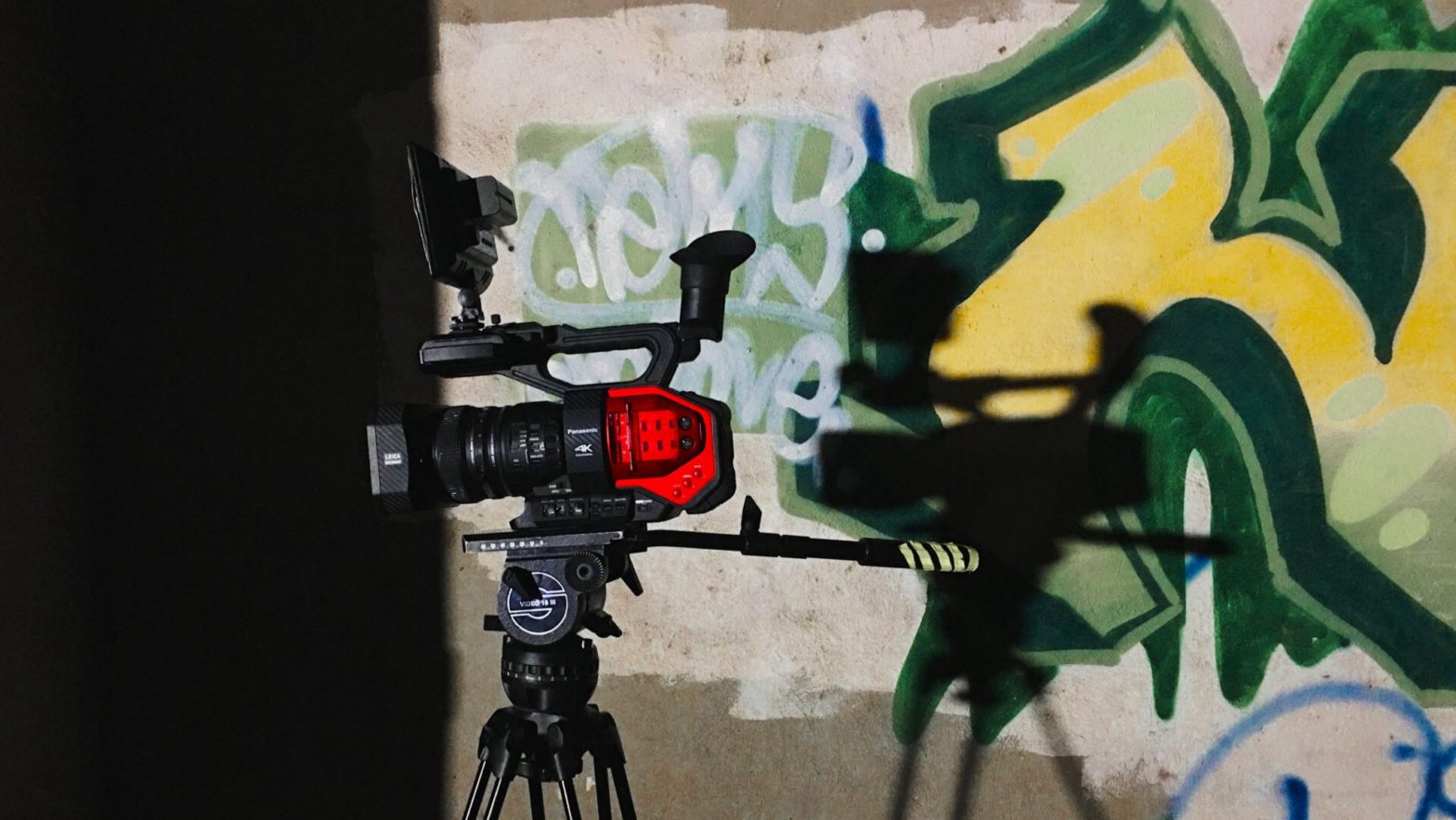
Tag: Blackmagic Cinema Camera 2.5K EF

  • Is It Worth Investing In Lenses For Micro 4/3โ€?

    Is It Worth Investing In Lenses For Micro 4/3โ€?

    Tyler Kraft posted this question on one of the many filmmaker Facebook groups Iโ€™m a member of:

    I recently choose to go with a Panasonic GH4 as my main camera that I plan to use for my upcoming low budget film. What do you all think of the Micro 4/3 sensor size? Is it worth investing in some lenses for it? Any suggestions for (cheap) lenses? (I have the Panasonic 14-140 and a speed booster to use a Nikon nifty fifty and Nikon 35-70mm F3.5 AI)

    Here was my reply:

    Micro 4/3โ€ is similar to Super 16 and lots of modern mainstream movies are shot on S16 film: Fruitvale Station, Black Swan, Hurt Locker, Moonrise Kingdom, Leaving Las Vegas, and Clerks all come to mind. My DVX200 has a 4/3 MOS sensor (and affixed 13x zoom lens) which I shot tons of cinematic work with. I even shot a feature film using the original Blackmagic Cinema Camera (M4/3) and cine lenses intended for Super 35.

    M4/3 is just a format. It provides a look as if you were choosing a film stock. Itโ€™s hard to get the background out of focus? So what? What if you want deeper focus? When I shoot 135 (approx Vistavision) Iโ€™m always stopping down to achieve deeper focus. It is incredibly hard to pull focus handheld at T2 on a โ€œfull frameโ€ sensor LOL. I knew a DP who only liked to go T4.5/6 split in S35, but I was very thankful because I was his 1AC LOL. Anyway, M4/3 (S16) is just a format, like S35 or 135 or S8 or IMAX, etc; you choose the one thatโ€™s right for the project and its budget.

    Regarding lenses: do not invest in lenses for a small format. Invest in lenses that cover syltandard formats like S35 or large formats like 135. A few years ago I invested in fast PL mount cine lenses (T2.1) that cover up to 135 format (what YouTubers call โ€œfull frameโ€, whatever that means). With a solid PL mount adapter I can adapt the lenses to almost any camera whose flange is shallow enough, including M4/3, E, RF and EF. The nice thing about M4/3 (and other mirrorless mounts) is the flange is so shallow you can adopt almost any sort of lens you like. So thereโ€™s no reason to get a cheap consumer Panasonic lens just because you bought a GH4. Use that speedbooster with that Nikon. Shoot a whole movie with it. Or get another Nikon lens thatโ€™s wider if you need it. The lenses usually only provide a little bit of character to your movieโ€™s look. The lenses are not going to be what really affects how the movie looks. The lighting is.

    Lighting and composition are the things that will make or break how your movie looks. The tools used on set only marginally affect the look; what they really do is affect how well you work on set. Good tools are effortless to work with. Crap tools are crap and slow you down and suck. Invest in good tools if youโ€™re really taking this movie thing seriouslyโ€ฆ

    GH4 is just okay. Itโ€™s a horrible filmmaking tool because itโ€™s a stills camera. Stills cameras have to be rigged out a bunch to make them useable. At the end of it all it might actually be cheaper to buy a proper digital cine camera instead of a DSLR or mirrorless and rig it out to behave like a proper video camera.

    But, I understand when youโ€™re starting out, you can buy 7 GH4s for the price of an EVA1 (which is excellent), or 10 for the price of my FS7II (which I turned into a mini Alexa). But but but, start investing in good lenses now. That way you can upgrade your camera bodies as texhnology and your budget improves over time, but the lenses will outlive all of your cameras, and youโ€ฆand your kids. Seriously consider saving up for proper PL-mount cinema lenses in a few years (either a set of fast primes, or an equivalent zoom). All you would need is a solid M4/3 to PL adapter for them to work on your GH4, for example. And PL cinema glass is getting cheaper and more plentiful every year. Just look at the ones by Sigma and DZO. The Arri equivalent lenses are $50-100K+.

    But for right now, use the lenses you have. Invest in good lighting and I donโ€™t mean those cheap, ugly, weak LED flatpanels.

  • Behind the Scenes of Ingress

    Behind the Scenes of Ingress

    A little throwback to 2014 when I was the cinematographer on writer and director Christian Blake’s sci-fi thriller feature film Ingress. This behind the scenes video was filmed during principal photography near Anchorage, Alaska, in October 2014.

    Which brings me to that time when a moose visited the set. We had just wrapped at a location and were waiting for the production vehicle to swing by and pick us up when this happened:

    In case you missed it, here is the official trailer of the film:

    I also served as an executive producer on the film.

  • My Cameras: A History

    My Cameras: A History

    Since watching Star Wars (possibly The Empire Strikes Back) as a wee little baby I had always been interested in photography, cinematography, and the moving image. Cameras, therefore, have been a large part of my life since the very beginning. Following is a history of my cameras (and me) throughout the years.

    In my youth (pre-high school) I had used the Kodak 104 Instamatic, a little plastic point and shoot 110 film camera. It changed my life, and I would not use an SLR camera until high school. In 1994 I was introduced to 35mm single lens reflex cameras with the Pentax K-1000, an inexpensive amateur device that required no batteries unless you wanted to take advantage of the exposure meter in the viewfinder. The K-1000 was assigned to me in journalism class during my sophomore year in high school.

    The next year, I was asked to take over the photography department while the journalism supervisor dealt with the reporters. I was then responsible for teaching use of the cameras, dark room technique and basic photography etiquette to my peers and upperclassmen students alike. And I was good at it. The kids learned a lot and their photographs got better as the semester trolled along.

    My senior year, the school upgraded to the Canon EOS Rebel. Gone were the days of K-mount fully manual, heavy metal cameras. Now, you could have a fully automatic experience with little photographic insight in a plastic, lightweight camera with an on board flash. These new auto focus cameras needed batteries and the consumer-class zoom kit lenses weren’t as sharp, fast or precise as the Pentax’s 50mm primes, but the Rebel did auto forward the film.

    After graduation, I signed up for a Discover Card on my way out of an English class my first semester of college. One of the first things I ever purchased on a credit card was a Canon Rebel XS-II kit along with a Canon case from Best Buy. The setup worked fine for several years until one day the curtain stopped working. I never sent it in for repair and because of my hectic work schedule, I silently walked away from photography.

    In 2002, after shooting some short films and getting my schedule in order, I decided to pick up a Canon PowerShot G3. I figured digital was the way to go for an uninterested consumer like myself and that’s because years ago I swore that I’d never go digital anyway. But that was also when I swore I’d never leave photography.

    The G3 worked great as I started to feel the pull back to photography. In 2003, I figured I would stay digital and move up toward the SLRs again: this time I got the Canon 300D Digital Rebel. The Rebel worked great until I dropped it after one of my first model shoots (in fact, I think it was my second model shoot ever) in 2004. The damage to my Rebel was an excuse to upgrade to the Canon EOS 20D.

    Four years later, the 20D has been so good to me, I hadn’t been concerned with upgrading camera bodies at all. Focusing instead on purchasing lenses such as the Canon EF 50mm f/1.8-II normal prime lens, as well as investing in a few affordable Canon L-series lenses. Because a camera body is just a light-tight box with a hole in it. Image quality and control is all about the glass in front of the body. I purchased a Canon EF 17-40mm f/4L USM normal/wide zoom lens, and a Canon EF 70-200mm f/2.8L USM telephoto zoom lens.

    In 2008 I decided to apply what I had learned about photography up to that point back into 35mm film. One of those “if only I knew then what I know now” things. I went old school and won at eBay auction the Canon FD-mount Canon AT-1 and a fast Canon FD-mount prime lenses. I also purchased a Canon PowerShot SD1100 IS as I began to value smaller cameras that could fit in my pocket and take anywhere. This was also the year I purchased a Sekonic light meter and began to properly expose myself to, well, proper exposure. The AT-1 is sitting on a shelf, while the SD1100 eventually was submerged in water and never recovered. 2008 is also the year I began to try my luck at videography and cinematography.

    After working on a few short films in 2008 and 2009 I realized that cinematography made me very happy. So, in March 2010 I purchased a Canon EOS Rebel T2i for the purpose of honing my video and cinema skills, as well as to supplement my indefatigable 20D. The 20D eventually began to eat my CF cards and died in the middle of a commercial jewelry photo shoot. Luckily, I had the T2i as a backup and so decided it was time to retire the 20D after six years of professional use. I wound up shooting quite a lot of short films, music videos, and television commercials, with my faithful T2i over the years, even as the rubber bits began to peel off due to the heat, salt water, and sand, and other rough elements I constantly exposed it to. April 2016 my little T2i died on a dry rental. I still haven’t gotten it back from whomever still has it.

    June 2013 I was finally able to purchase the Blackmagic Cinema Camera 2.5K EF (BMCC), paid in full by a commercial job for a furniture store client. The camera worked flawlessly on its trial run, however the hard drive I saved the footage to did not. I lost most of the footage, pissed off the client, experienced the positive side of having a paper trail (contracts, release forms, etc), and learned a valuable lesson in backup redundancy.

    January 2016 I was able to purchase my first 135-format digital camera, the Canon EOS 6D. An upgrade from the soon-to-be-DOA T2i, the 6D became my primary photography camera until I decided to use it to also replace the BMCC to shoot documentaries and other video work I really needed a proper video camera for as the BMCC was too damn clumsy to work with.

    I finally got that proper video camera in May 2016 when I purchased the Panasonic AG-DVX200 from a vendor in Dallas, TX. The DVX200 has served the 90% of my client work: videography. Because DVX200 also sported a logarithmic profile, I decided to also use the camera on jobs where I might normally have preferred the BMCC and its superior ProRes codecs or CinemaDNG raw, such as television commercials and short films. But, the DVX200 was much simpler to work with, despite its limited 8-bit 4:2:0 codec that was only about as good as the T2i ever was. DVX200 continues to serve me for video work, but I knew I would need a special camera for that other 10% of my work: cinema.

    July 2017 I took to the skies with the DJI Mavic Pro and began to pursue legitimacy as a commercial UAS remote pilot.

    Taking on a job as a state college marketing department’s photographer (read: button smasher), I began to lose my love for the art. I decided I needed a focused, deceptively simple, but most of all fun, camera only to be used for stills in an effort to rekindle the passion. That camera, to me, was somewhere in Fuji’s X100-series. Over the years I had been thinking about the X100 cameras, and as I began to grow tired of what used to be my biggest passion in life, I decided to take the plunge on the most up-to-date, most mature, and most fully realized version of the series. So, in August 2017, I purchased my Fujifilm X100F. It’s the kind of camera I can take with me anywhere, it communicates with my iPhone and I can make pretty photos with it in just about any situation. The film simulations are adorable. It’s fast, nimble, and challenges me to be a better photographer and artist in every respect. I adore my X100F.

    February 2018 was finally the time to get that special cinema camera. After years of careful consideration, I decided to purchase the Sony PXW-FS7M2 from a vendor in Austin, TX. A mature, improved FS7, the Mark 2 is pretty much everything I ever wanted in a specialized cinema camera, as well as in a general purpose video camera. The locking lever E-mount and electronic variable ND filtration were the paramount reasons for considering the FS7M2 over the original โ€“ and slightly less expensive โ€“ FS7. Combined with a lovely CineEI mode and a certain set of LUTs, I am convinced I own now a miniature Arri Amira. So far I have only used it a little bit (just bought it a few weeks ago) but it is proving to be my most favorite camera I’ve ever owned. I can’t wait to see what the future has in store.

    June 16, 2019 โ€“ Purchased a GoPro Fusion 360 at Best Buy in Brownsville, Texas.

    December 7, 2019 โ€“ Purchased a Canon EOS 6D Mark II at Best Buy in Brownsville, Texas, along with a Canon EF 50mm f/1.4 USM, Canon EF 85mm f/1.8 USM, and Canon Speedlite 430EX III-RT external flash.

    April 10, 2021 โ€“ Purchased a Sony a6400 at Precision Camera in Austin, Texas, after a Mother’s Day photo session.

    October 7, 2022 โ€“ Purchased a RED Komodo through B&H Photo’s website. I was able to pull the trigger on this after careful consideration since the camera’s announcement, and upon being paid for working on the feature film M30 Oxy as DP. As of November 21 I have filmed pickups for Big Trip’s Phoenix, shot a commercial for Intrigue Boutique, and the music video for Ainsley Costello’s Cherry On Top. Because of it’s size, ease of use and customization, and easy ProRes workflow with Final Cut Pro, the Komodo has quickly become my most favorite camera I’ve ever owned.

    This article was originally titled “My Photo Cameras: A History” and written July 5, 2008, before I became a cinematographer.

  • Panasonic’s “Next Camera”

    Panasonic’s “Next Camera”

    There is only speculation at this point. Panasonic has announced a new cinema camera at NAB Show 2017 this week. However, that’s all anyone really knows. There are exactly zero details about the camera released by Panasonic during the tease. Panasonic representatives on the NAB Show floor have offered only scanty hints of what this new camera is all about.

    A mock-up of the new camera rests under veil within a thick glass case at the Panasonic booth at NAB Show between the new GH5 and the current Varicam line-up of LT, 35, and Pure. This suggests a camera that fills that void, offering more capability than the GH5, a stills camera, but not as robust (or expensive) as the Varicam LT. The bullet points above the veiled prop admit the camera is “small and light,” has “cinematic imagery,” will feature “low-cost media, workflow,” and will be “available Fall 2017.” That’s it. When asked what to call this new mystery camera, Mitch Gross, Panasonic North America’s Cinema Product Manager, during an interview stated simply it is Panasonic’s “next camera.”

    How soon until the full reveal? Thankfully, that will come the first week of June at Cine Gear Expo in Los Angeles, only five weeks away.

    Personally, I have been dreaming of a successor to the venerable, yet under-appreciated, AF100 from 2010. Being an owner/operator of DVX200, I am in love with the fixed-lens camcorder for video projects and some cinema-style work such as TV commercials and music videos. However, the DVX200’s biggest advantage is also it’s biggest obstacle: the fixed lens. It’s a great lens, but having a uni-body camcorder means I never will have the option to use something else. I’m stuck with that lens. Don’t get me wrong: it’s actually wonderful to never worry about changing lenses, carrying those lenses with me everywhere, risking dropping them during a change, dirtying up the sensor, and other things; but, man, it sure is nice to change lenses sometimes.

    For the majority of my work over the past few years has been reality in-nature. I’ve shot a lot of corporate videos, event videos, wedding videos, interviews, news segments, et cetera. Before I purchased DVX200, I was using my current cinema camera, the Blackmagic Cinema Camera 2.5K EF which I purchased in 2013. Also, a great camera, but hell to use in a reality situation. The cage and rigging makes it bulky and heavy, the lenses need to be changed. There’s no ND wheel. White balancing is a chore. Audio has to be recorded externally, and there’s a big brick battery lazily affixed to the cage. It’s fine for a controlled set, but daunting when covering an event; something that only happens once.

    With DVX200, since May of last year, I’ve only shot a few projects with the Blackmagic Cinema Camera as the majority of my work has been videography. 2016 was also the year I finally purchased a set of proper cinema lenses: the PL-mount SLR Magic APO Hyperprimes. Now, I need to start looking at upgrading my cinema camera. Lately, I have been eyeing the Blackmagic Ursa Mini Pro. However, I most likely will not be in a position ready-to-buy until end of the year. With Panasonic’s tease of a new cinema camera that just might be a spiritual successor to the AF100, or a straight-up AF200, my interest is piqued.

    Panasonic Pro Europe posted this to their Instagram account.

    I left the following comment:

    So, I’m going to go out on a limb and guess it’s [basically] an AF200: DVX200 body and features, m4/3 lens mount (with Super 35 sensor?), internal 10-bit 4:2:2 ProRes (please!) up to DCI 4K, and that flipping LCD has a snap-on loupe. I imagine it’d actually be the same 4/3″ sensor in the GH5. Not a Varicam, but would play well with V-log L. 13 stops of dynamic range? Probably aiming to compete with FS5 and 7, and C100-300. Might even be a non-raw competitor to Ursa Mini, and if it’s priced lower, all bets are off. Whatever this thing is, I am excited. We’ll know at Cine Gear Expo…

    Looking at the lens in the silhouette image, it is definitely a Sigma 24-35mm F2 DG HSM Art. I’m going to venture that is a fixed EF mount. I would imagine it is a M4/3 sensor, however, Panasonic might be alright with letting us have a Super 35 sensor. It’s not going to be a Varicam. It’s going to be a spiritual successor to the AF100 (or, the AF200). It has the same silhouette as the DVX200, minus the rear EVF and affixed lens. AF100 was basically an HVX200 body. This seems like the logical progression of things. It took forever for a successor to DVX100, and it was announced in 2015. I think this would make sense to announce an AF100 successor (again, either spiritually or a literal AF200), that would share the concept of the DVX200, but with an interchangeable lens and, hopefully, better internal codecs. Has anyone noticed that the LCD swivels horizontally (yaw roll)? That, by itself, is exciting.

    Personally, I’d love an Ursa Mini Pro…unless something better comes along at the same or better price when I’m ready to buy. And, technically, i am doing just fine with my current cameras so I don’t want to upgrade my cinema camera until I can afford to do so, and with a product I know will serve mine and my clients’ needs. But, I have a cinema camera. I needed to upgrade the video camera I bought in 2010, so I bought the DVX200 (again, I would LOVE a cinema camera in a DVX200 body). Then I needed cinema glass, and then a nicer field audio recorder, etc. Late 2017/early 2018, I’m looking to upgrade the cinema camera I bought in 2013. Ursa Mini Pro has been the top contender. Who knows about this new Panasonic? I like Panasonic very, very much. So, even if it doesn’t do internal raw, if everything else is very strong, my choice could definitely go in Panasonic’s direction.

    Meanwhile, user Osslund on DVXuser posted the following rumor yesterday:

    Just got this info about the new camera. It will have a S35 sensor and 14 stops of dynamic range. 4k up to 60fps. 1080p up to 120fps. All the usual stuff like ND, SDI/HDMI out. The body is very light weight at about 1 kg. Media used will be SDXC cards with dual slot capacity.

    The camera pars [sic] can be broken down and the shape of the camera is a mix of C100 and FS5. As is the price in the league of a C100 mkII.

    If even parts of that are actually correct, Panasonic’s “next camera” could very well be an Ursa Mini Pro killer for me. Regardless, the prospect of an “AF200” is super exciting. Too bad I can’t be in Las Vegas this week to try and peak through the cloth.

  • Achieving the Film “Look”

    Achieving the Film “Look”

    Traditionally, motion pictures shot on 35mm film have a certain “look.” Ostensibly, this “look” is achieved with digital cameras by shooting at 24 frames per second, with no more, or less, than two shutter exposures per frame, a shallow depth of field, with a field of view and dynamic range relatively similar to that of human vision. So, we can say 24 fps, 1/48 or 180ยบ shutter, an exposure in the Super 35 or Academy 35 standards no more narrow than T5.6, and a lens length somewhere around 28mm in the previously mentioned standards.

    But, anyone can do this.

    The thing you see mentioned less is lighting for drama, interesting composition, motivated blocking, when to be subtle, when not to be subtle, etc.; all measured appropriately in the service of advancing the story. Production design, costume design, and other departments all align as part of a film’s visual language to advance the emotion of the story.

    When done well, all are seamless and never thought of; never does a good movie scream out “look at me!” in terms of how well someone did their job with the design or build or performance. The audience is looking and committed to living briefly in the world projected before their eyes by commenting on how well they were transported there. Only afterward and on subsequent viewings should an audience be allowed to think, “gosh, those buildings are well designed.” Or, “I wonder how they got those cars to fly.” The suspension of disbelief is only as good as the subtlety of the work of the motion picture crew. Later, you can exclaim, “the person who designed those costumes should get an award.” The audience should not be imagining what lens was used, where the matte painting ends or what other movie they saw that actor in.

    Therefore, I propose that suspension of disbelief created by a well-executed plan involving craftsmanship, artistry and storytelling, is as important to achieving “the film look” as any of the technical aspects. Remember, our role as filmmaker, particularly as a cinematographer, is a heady combination of science and art. Those are our tools more than any frame per second.

    I would love to hear your thoughts in the comments below.

  • Bert Ogden TV Spots Filmed with Blackmagic Cinema Camera 2.5K EF

    Bert Ogden TV Spots Filmed with Blackmagic Cinema Camera 2.5K EF

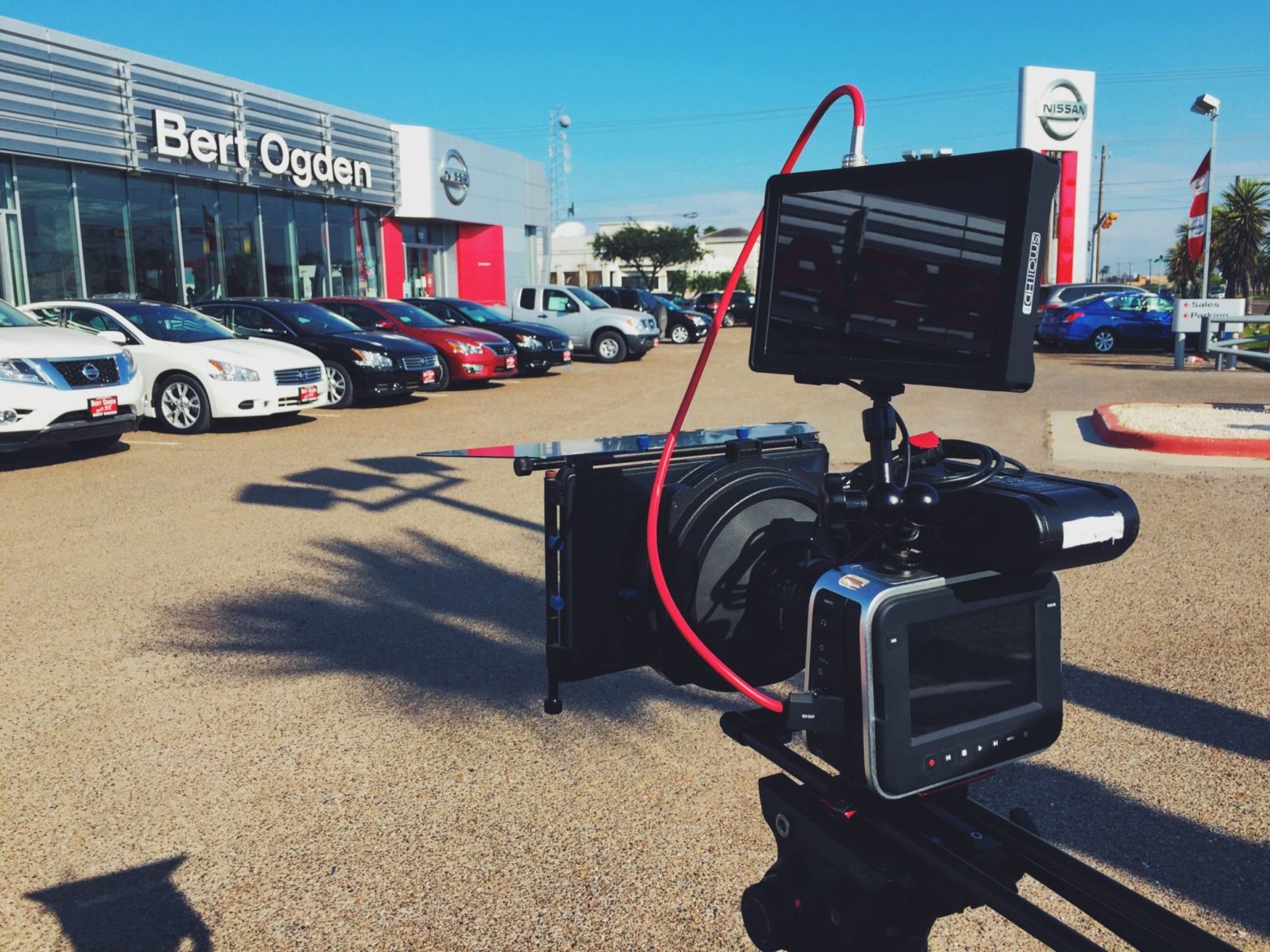
    The Bert Ogden family of auto dealerships hired me to shoot footage of all their lots across south Texas for some upcoming television spots. In the finished spot [no longer available] I did the lot shots, building exteriors, the shots of the cars flopping around on the lot and the running footage of the blue truck. It took three days to shoot all eleven dealerships. Thanks to Marsha Green, Cesar Castillo and Pete Salas of the Bert Ogden marketing department.

    BMCC on-location at Bert Ogden Nissan.
    Me and Pete, editor.
    Marsha directs.
    Producer Cesar’s truck converted into a temporary camera car.
    The flag over Bert Ogden Nissan.
    Blackmagic Cinema Camera in the bed of the camera car.
    During the shoot, Pharr PD pulled over someone who parked behind the camera car and blocked us in, holding up production for a few minutes. But we were waiting for a picture car to be washed so, it worked out.
    Later that day I was shooting footage at their BMW dealership. This is the view through the SmallHD AC7. Note the reflection of my iPhone 6 in its Otterbox.
    The next day I was shooting their Chevy dealership when I cut myself on a screw sticking out of my car door from a missing panel as I tried to close it. That’s tissue paper and a velcro cable tie holding me together.
    BMCC on-location at Bert Ogden Chevy.